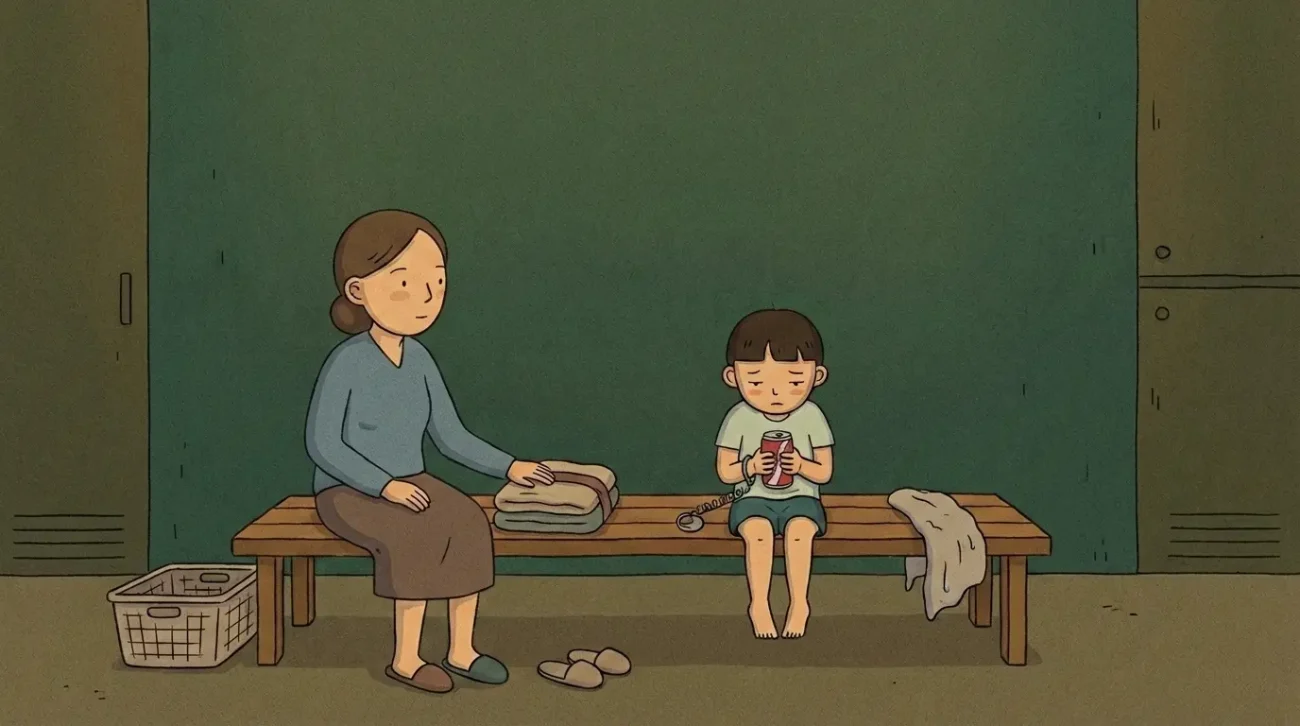
The first time I mention this to someone from outside Korea, I can see the question forming before they even ask it. I grew up going to the korean public bathhouse — daejung mogyoktang (대중목욕탕) — from an age I can barely remember, and when I mention that, foreigners tend to look at me with a particular expression, something between confusion and mild disbelief, and ask why anyone would go outside just to wash with strangers. To me, it was never a strange thing. It was simply what we did. But the moment someone turns it into a question, I realize how deep inside the ordinary that life was for me. Being pulled along by my mother in the dark before the bathhouse even opened. Receiving a cold can of cola after the scrubbing was done, my skin raw and my body still hot. My mother rubbing milk onto her own arms and then onto mine, without explanation, as if that was simply the next step.
So when people ask me to describe the korean public bathhouse, I find it hard to say it was just a place to wash. It was that, yes. But that answer always falls a little short. The water was hot, the air was permanently humid, voices echoed off the tiles, and somehow the body loosened faster there than anywhere at home. There were mothers and children and grandmothers, and the sound of hands scrubbing cloth and towels being wrung out. When I hear someone call a jjimjilbang (찜질방) a Korean sauna, I always feel the urge to go back one step further and describe what came before it.
Because to me, the public bathhouse carries a slightly older kind of warmth.
The Korean Public Bathhouse Was a Practical Space Built Around the Scarcity of Hot Water
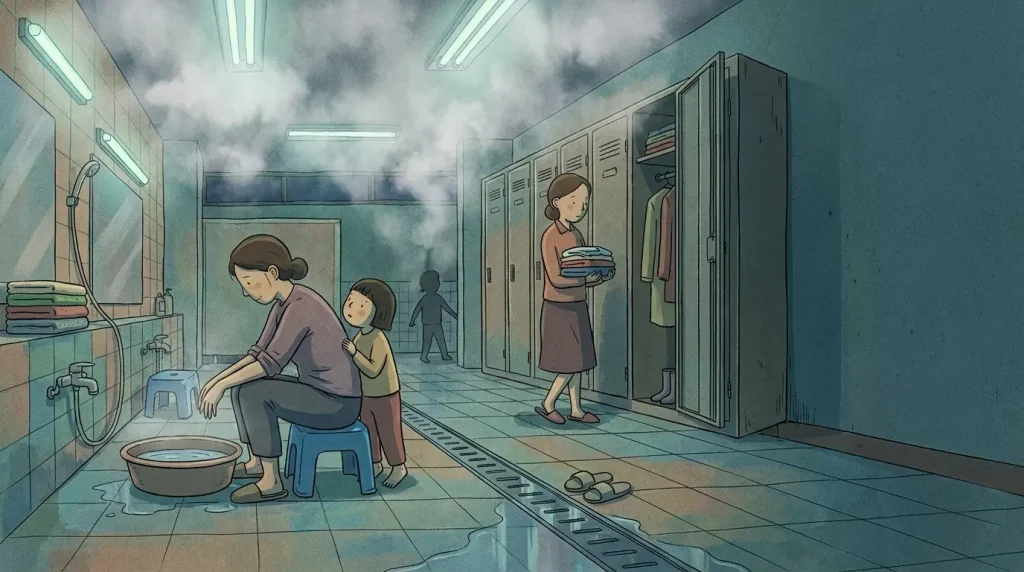
When I was growing up, the idea of showering at home and calling it done was not as automatic as it is now. You could wash at home, but the feeling of having enough hot water, enough space, enough time to properly soak and scrub — that was different. The korean public bathhouse was not a luxury in the way that might sound to someone outside Korea. It was closer to a utility. A place where you went to do the thing that home could not fully do. I came to understand this background later, but at the time I simply knew that the bathhouse was where you went when you wanted to wash properly. The rhythm was: partial washing at home on ordinary days, the bathhouse when it was time to do it right.
When foreigners hear this, the first question is usually when this culture started and why. I am not the kind of person who memorized dates, but I know that when I was young, there were three or four bathhouses within easy walking distance of almost every neighborhood I knew. That kind of density does not appear overnight. It grows because people need it. And in a period when home hot water was not something every household had in abundance, a warm communal space with deep soaking tubs and room to wash properly was not a novelty. It was part of how life was organized.
Looking back, that ordinariness was itself the point.
What I Remember From Childhood Is Heat, Discomfort, and the Cola That Came After
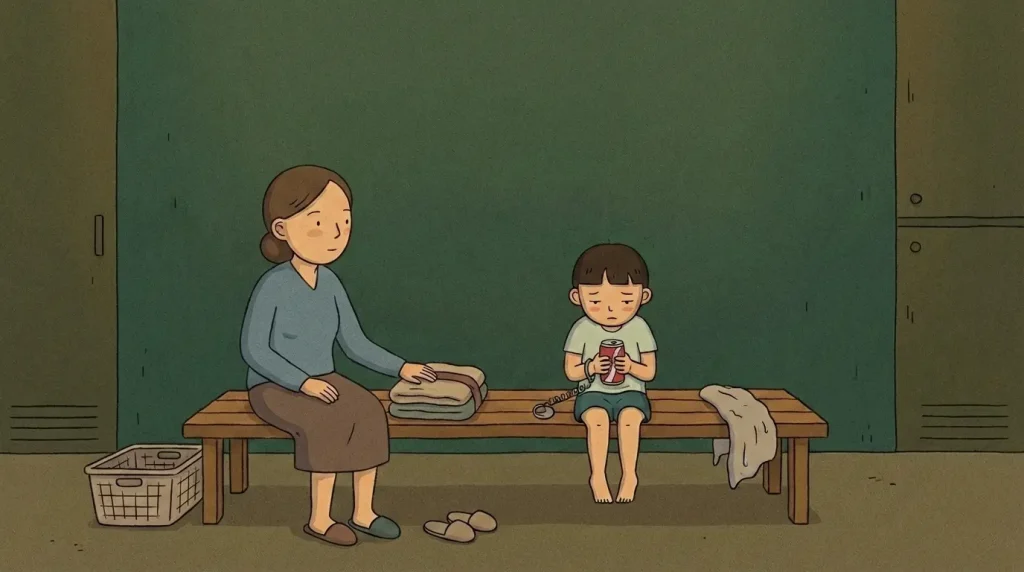
I did not love the bathhouse as a child. My first clear memories of it are of feeling too hot, slightly suffocated, and then the particular pain of having my mother scrub my skin during ttae milgi (때 밀기). I did not understand at the time why it needed to be that thorough. My mother always said the body needed to be properly cleared out, that anything less was not really clean. I accepted this without quite believing it, and mostly waited for it to end.
But the memory never settled into something purely unpleasant. Because when the scrubbing was done and we came out, my mother always bought me a cold cola. That cola did not taste like the cola I drank at home. The combination of heat and humidity and a body that had just been thoroughly scrubbed, followed by cold carbonation going straight down — it landed differently. Even now, when I think of the korean public bathhouse, the sensation of that cola arrives before almost anything else. So the bathhouse was uncomfortable in one part and had something worth waiting for at the end, and that combination is probably why it stayed in my memory the way it did.
As I got a little older, a different kind of discomfort appeared. In early elementary school, it became awkward to run into male classmates in the women’s section. This happened because fathers in Korea at that time were working extremely long hours — longer, even, than they do now — and the person who took children to the bathhouse was almost always the mother. So mothers would sometimes bring young sons into the women’s section, quietly adjusting the age if anyone asked. It was not a scandal. It was a practical arrangement. But for the children inside, there was a certain age at which it suddenly became embarrassing, and I knew that age from the inside.
The Mothers Did Not Just Wash There — They Finished Small Parts of the Household While They Were at It
This is the part that surprises foreigners most when I describe it. The korean public bathhouse was also, for many women, a place to do laundry. Not always with a large bag of clothes brought from home — in my mother’s case, it was simpler than that. She would wash the underwear we had worn that day, right there in the bathhouse, and we would change into clean clothes she had packed before leaving. When we came home, the worn things were already clean. I did not register this as unusual at the time. It was simply what happened.
Other women brought more: socks, small towels, additional underwear, things that could be soaked in warm water and washed by hand while the body was being taken care of at the same time. The warm water was already there. The time was already being spent. It made a kind of practical sense that I only fully appreciated later.
And the washing did not stop at fabric. After bathing, my mother would sometimes rub white milk across her arms and legs, and then across mine as well. I remember the smell of it — faintly rich, slightly warm from the steam already in the air, strange in a way that stayed with me. Whether it actually did anything for the skin, I cannot say with certainty. It was simply believed to be good for it, and that belief was enough. Seeing someone rub yogurt or milk on themselves in a bathhouse was not a thing that needed explaining. It was one of those practices that existed because people had always done it, and doing it felt like taking care.
The more I think about these details, the more clearly the bathhouse appears to me as a place of daily life rather than a facility.
The Early Morning Before a Holiday Had a Completely Different Quality
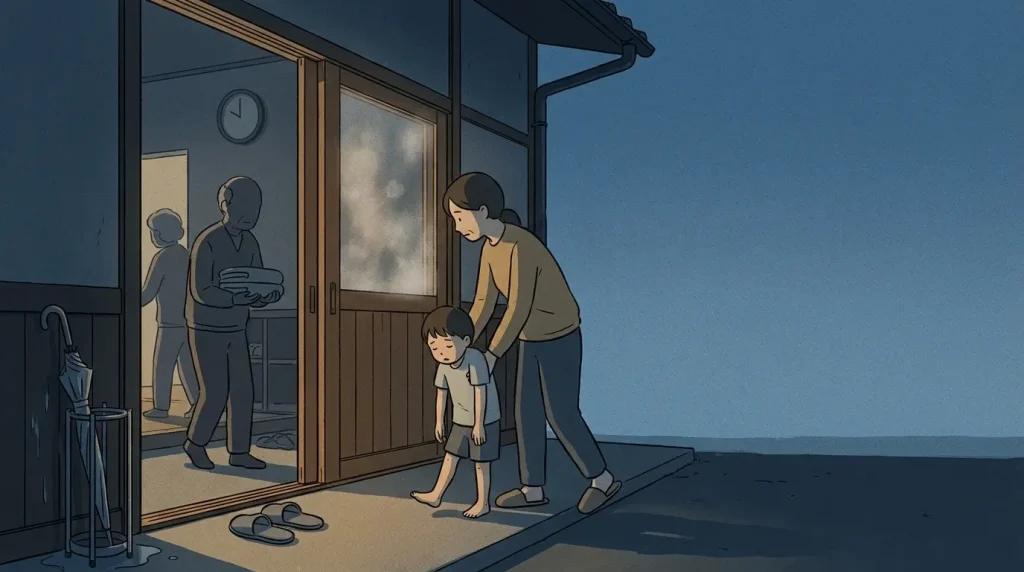
The bathhouse memory I can recall most precisely is not from the middle of an ordinary day but from early morning. We went most weekends, sometimes every two weeks, but in the days before major holidays like Lunar New Year or Chuseok, the korean public bathhouse became too crowded to use comfortably. So my mother would wake me before dawn and get us there the moment the doors opened. I was never fully awake for this. The air inside was thick with steam, and the people already there at that hour were almost all elderly — grandmothers and grandfathers who had arrived even earlier.
That scene feels slightly unreal even now. Outside it was still early. Inside, the day seemed to have been going for a long time already. The water had been changed overnight after the previous day’s closing, so everything felt freshly cleaned — the surfaces still slick, the water clear in a way that it would not be by mid-morning. I moved through it all half-asleep, following my mother, noticing things without quite processing them. The humidity, the particular quiet of people who were not yet talking much, the warm floor under bare feet.
To a foreigner, the question of why anyone would go to a bathhouse before dawn ahead of a holiday might need an answer. To me it never required one. The body needed to be properly prepared before a major gathering. Getting there before the crowds was simply the sensible way to do it. Those two reasons together made the early morning the right time, and the air at that hour became something I still associate with the days before something important.
The Towel Rule Between the Men’s and Women’s Sections Was Something I Understood Only Later
I should say clearly that I never entered the men’s section, so I cannot speak from direct experience. But I heard often enough — from television, from people who had been — that the men’s side kept stacks of clean towels available for use without counting. The women’s side was different. Two towels was the standard, and treating that as the limit felt natural by the time I was old enough to notice it. I never questioned it as a child. It was simply how things were.
The explanation I heard most often, and that has stayed with me, is that in earlier years it was not uncommon for women to take towels home with them. So the bathhouses began limiting the supply rather than replacing what kept disappearing. I cannot verify this from a historical record. But the practice itself — women’s towels counted carefully, men’s towels stacked freely — persisted well into the period I remember, and probably beyond it. A small rule with an unexplained origin, still in effect because no one had strong enough reason to change it.
I think about this sometimes when something present-day seems to have no obvious logic. Often the logic is just old enough that no one remembers introducing it.
Where the Public Bathhouse Went, and What Stayed Behind
When I was young, there were three or four bathhouses within a short walk of most neighborhoods I knew. That was simply how the neighborhood was organized. Over time that changed. The ones with enough business and space became jjimjilbangs — adding heated rooms, rest areas, food, places to sleep. The ones that could not make that transition closed. So when I look at a jjimjilbang now, I do not see an entirely new invention. I see what the korean public bathhouse became when it had to become something larger to survive.
When I watched Love Forecast (오늘의 연애, 2015), there was a bar built inside what had been a bathhouse, the original tiles and structure kept mostly intact. Seeing it brought back a specific quality of memory — not the events, but the texture of the place. The particular visual of those tiles, that layout, triggered something I had not expected. It confirmed for me that the bathhouse did not disappear entirely. It just changed shape.
What made me feel something closer to loss was reading that jjimjilbangs themselves were closing. Because the thing I would genuinely miss is the scrubbing. Not the concept of it, but the specific sensation that only comes from being in that kind of space — the heat, the water, the humidity, the rhythm of the whole process. Scrubbing at home is not the same. I can do it. But the feeling afterward is different, and I cannot explain exactly why in a way that would satisfy a scientist. It simply is.
When I See a Jjimjilbang Now, the Public Bathhouse Is Always One Layer Underneath It
Some people encounter a jjimjilbang for the first time and call it a Korean sauna. That is not wrong. But when I look at the same scene — people in matching clothes on heated floors, someone eating a boiled egg, someone already asleep — I see something older underneath it. The steam and tiles of the korean public bathhouse. The mothers doing laundry. The cold cola after the scrubbing. The grandmothers already there when the doors opened at dawn.
What I would want someone new to this to understand is not a history lesson. It is simpler than that. The jjimjilbang did not arrive from nowhere. It came from a longer habit of Koreans treating the act of washing as something that required a proper place, enough hot water, enough time, and sometimes other people nearby. That habit began in the public bathhouse, and something of it is still present in every heated room and scrubbing table that exists today.
And when I think back to the doors my mother pulled me through before I was old enough to question any of it, I understand now that those were not just the entrance to a place for washing. They were where I first learned that taking care of the body was a thing Koreans did together, and seriously, and often before anyone else was awake.
The question I am asked most often is whether it is strange to be completely undressed in a space with people you do not know.
The honest answer is that it stopped feeling strange before I was old enough to have an opinion about it. By the time I could form a thought about the arrangement, it was simply the arrangement. What I remember noticing as a child was not the undressing but the sounds — water hitting tile, towels being wrung, voices carrying in ways they did not carry anywhere else. The nakedness was the condition of being there, not the point of being there. Once that distinction settles in, the question mostly answers itself.
People want to know what to do if they have never had someone scrub their body before and are not sure what to expect.
I would say: expect it to feel more direct than you imagined, and then expect it to end sooner than you thought it would. The sesinsa (세신사) is not trying to relax you. They are trying to finish. There is an efficiency to the whole process that I find easier to respect than a spa treatment, which always seems to be performing something. This does not. When it is over, your skin will feel like it has been returned to an earlier version of itself, and you will probably stand in the shower for a moment just noticing that. That part is worth planning for.
Some people ask whether the milk and yogurt rubbing is still practiced, or whether it belongs to a different era.
I cannot speak to what every bathhouse in Korea is doing right now. What I can say is that I grew up watching women treat it as an ordinary next step after washing, the same way someone might apply lotion without announcing it. My mother did it. I did it alongside her. Whether a practice like that continues depends less on official recommendations than on whether the people who grew up with it keep doing it when they have the chance. My guess is that somewhere, someone is still rubbing cold milk onto warm skin in a bathhouse, and finding it completely unremarkable.
A question that comes up occasionally is whether children still go to the bathhouse with their mothers the way they did when I was young.
The social boundaries around this have tightened noticeably since my childhood. The unspoken negotiations my mother’s generation made — arriving early, adjusting details if asked — are less available now. Whether this represents progress or a loss probably depends on who you ask and which side of those negotiations they were on. I was young enough that the embarrassment I remember was my own, not caused by any rule. The rules caught up with the embarrassment eventually. That is usually how these things go.
The question about the towel difference between the men’s and women’s sections comes up more than I expected.
I always find this one slightly funny to explain, because the explanation — women took towels home, so the supply was limited, and the limitation remained long after the original reason faded — is such a perfect example of how rules outlive their reasons. I did not experience it as unfair when I was young because I did not know there was a comparison to make. It was only when someone pointed it out from the outside that I saw it as a rule at all. Most of the structures you grow up inside look like the natural shape of things until someone asks why they are that shape.
The last question, and the one I find hardest to answer quickly, is what a person should actually feel when they visit a bathhouse for the first time.
I think the right answer is: nothing in particular, and then quite a lot. The first few minutes are logistical — where to go, what to do with the ring on your wrist, which room is which. Once those resolve themselves, something else tends to happen. The heat, the water, the rhythm of moving between them — it asks the body to slow down in a way that most environments do not. I cannot promise that everyone experiences this. But I have not met many people who came out of a proper bathhouse visit and said nothing had changed. Usually something had, even if they could not name it precisely. That unnamed thing is probably what the korean public bathhouse has always been for.
