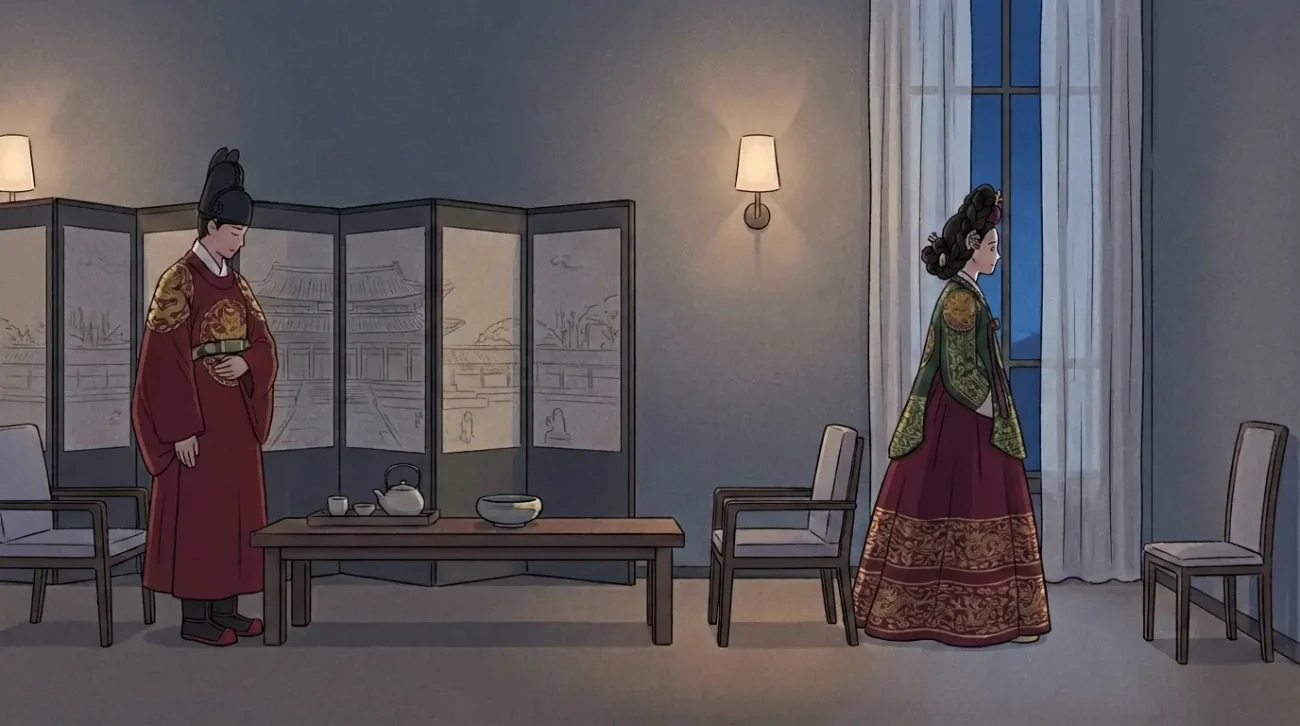
When Lovely Runner ended, the question that started appearing everywhere in K-Drama communities was the same one: what is Byeon Woo-seok doing next? I wasn’t particularly interested. I’m not his fan. But when the premise of Perfect Crown landed, something shifted. A modern Korea imagined as a constitutional monarchy. IU as a chaebol heiress who has everything except a royal title. Byeon Woo-seok as a prince who has a title and very little else. That setup pressed on something I had been waiting for — something that had nothing to do with either of them, and everything to do with a manhwa I borrowed from a friend in middle school.
Eight Months to Make
IU appeared on the Korean YouTube channel Pinggye-go and mentioned that filming Perfect Crown took about eight months. For a single drama, that’s a long time. When asked why, she kept her answer short. The team had spent that time trying to capture the beauty of Korea, she said, and that took longer than expected.
She said it briefly. It stayed with me longer than that.
Instead of building sets, the production team went looking for real places. They traveled to find locations that held something specifically and visually Korean, then brought cameras to those spaces. If you find yourself pausing a scene and wondering where that street is, or what that courtyard looks like in person, that reaction was built into the show from the beginning. Eight months is what it takes when every location is a decision.
Did Korea Actually Have a Royal Family
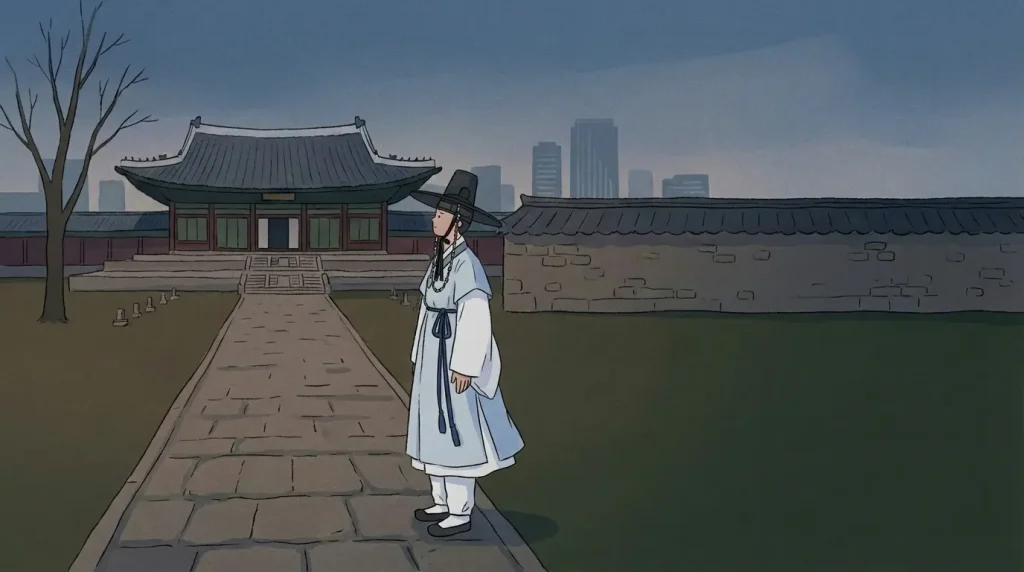
There’s a question that will occur to most people watching Perfect Crown at some point. Did Korea actually have a royal family?
It did. And before I answer that properly, there’s something worth saying first.
Many Koreans don’t say this easily about their own country, but the world classifies South Korea as a developed nation. The IMF does. The World Bank does. The United Nations does. What makes that classification unusual is the history behind it. Less than a hundred years ago, a kingdom called Joseon (조선) collapsed under Japanese annexation. South Korea is one of the very few countries in the world that experienced colonial rule in the twentieth century and still arrived at developed-nation status. Before any of that happened, Korea was a monarchy.
Joseon began in 1392 and lasted more than five hundred years. In the late nineteenth century, Emperor Gojong declared the Daehan Jeguk (대한제국), the Korean Empire, positioning Korea as an independent nation rather than a state in China’s orbit. That declaration lasted thirteen years. In 1910, Japan annexed Korea and the dynasty ended. Koreans resisted strongly. Independence movements continued across decades, and in 1945, liberation came.
So if the crown in Perfect Crown feels like pure fantasy, it’s because history has receded far enough to make it feel that way. The sageuk (사극), historical dramas, that fill Korean television are built from a mix of real events and a writer’s imagination. History provides the bones. The drama adds everything else.
This Premise Has Been Here Before
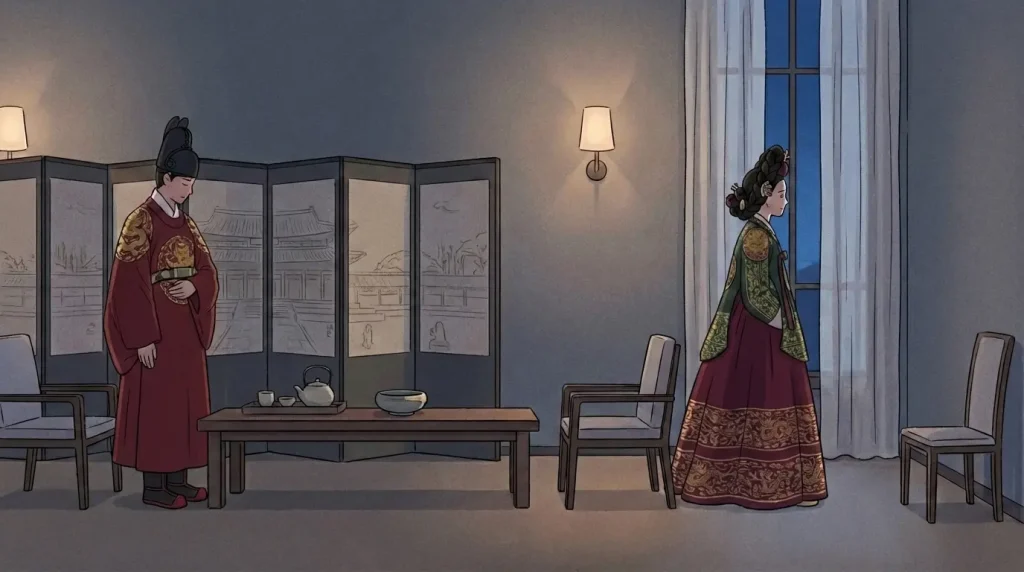
The first time I encountered this particular setup, it wasn’t a drama at all. It was a manhwa.
There was a comic I borrowed from a friend during my school years. It was called Goong, which translates roughly as Palace. The premise was this: in a modern Korea where the monarchy still exists, an ordinary high school girl is arranged to marry the crown prince. By the time the drama adaptation was announced in 2006, I already knew everything that was going to happen. I’d read it. So I watched the show the way you watch something when you already know the plot — for the actors, for the way familiar scenes translate to a screen.
Princess Hours (Goong, 2006)
The male lead was Ju Ji-hoon. He’s now known internationally as the crown prince in Netflix’s Kingdom, but in 2006, the conversation around him was very different. At that time in Korea, the standard of what counted as a handsome leading man was specific: double eyelids, a particular depth to the eyes. Ju Ji-hoon didn’t fit that description, and the reactions reflected it. People said he wasn’t good-looking enough for the role. He still brings this up in interviews, more than twenty years later, laughing at himself — saying that even by his own assessment, he wasn’t meeting the standard. The fact that this self-deprecating joke is still being told is its own kind of evidence for how deeply that drama settled into people’s memories.
The irony is worth noting. Ju Ji-hoon played royalty in Princess Hours and played royalty again in Kingdom — the same basic role, a generation apart. In Princess Hours, he was called an unattractive crown prince. In Kingdom, international audiences were captivated. Same actor, same role. The standard had moved, not the performance. When Kingdom came out and overseas fans reacted the way they did, I found that genuinely ironic.
If you’re thinking of watching Princess Hours, it’s also worth paying attention to the actress who played opposite him. Yoon Eun-hye doesn’t appear in dramas often these days, but she came to acting the same way IU did in Perfect Crown — as a singer first. The difference is the era. Yoon Eun-hye was a member of Baby V.O.X, one of South Korea’s first generation of girl groups. If you know anything about the history of K-Pop, that name will mean something to you.
The King 2 Hearts (2012)
Ha Ji-won and Lee Seung-gi led this one. The drama took the same basic premise and added a second impossible layer on top of it. Not only does modern Korea have a monarchy, but the peninsula is still divided North and South — and a romance develops between the Southern crown prince and a woman from the North. Two entirely implausible premises, stacked.
That combination could have collapsed under its own weight, but Ha Ji-won and Lee Seung-gi held it together. What stayed with me wasn’t the romance itself but the slower process of two people from opposite sides learning to understand each other. The same imaginative question, pointed in a different direction.
The King: Eternal Monarch (2020)
Written by Kim Eun-sook, starring Lee Min-ho and Kim Go-eun. Since this one is more recent and Lee Min-ho was the lead, most people reading this will probably already know it exists.
The setup here was considerably more intricate than either of the previous two. Two parallel worlds exist simultaneously — a constitutional monarchy Korea and the Republic of Korea as it actually is — and the story moves between them. Watching it, there were several moments where I lost track of which world I was in. The reaction that it was difficult to follow was widespread, and I agreed with that. I watched it to the end anyway. There’s something about royal fantasy, specifically, that seems to pull harder the more complicated the architecture around it becomes. Lee Min-ho arriving on a white horse in the opening sequence explains that pull as well as anything could.
If Perfect Crown is working for you, these three are worth finding. They’re all asking the same question through different lenses. If you want to go straight to something more recent, The King: Eternal Monarch is the easiest entry point. But there’s also something specific about watching Princess Hours in its original form — the pacing, the aesthetic, the particular way 2006 felt — that a remake would have to work hard to reproduce.
What I Was Actually Waiting For
Honestly, I didn’t expect Perfect Crown to arrive first. I was waiting for something else.
A Princess Hours remake.
The leads from the 2006 drama — Yoon Eun-hye, Ju Ji-hoon — are in their forties now. That’s how much time has passed. When news came out that a remake was in development, something shifted. The idea of that story told again by a new generation of actors, on a contemporary screen — I wanted to see that. I’d read the manhwa as a teenager, watched the drama when it aired, and a remake felt like the next natural chapter. The announcement came. And then it stalled, and has stayed stalled since.
If Perfect Crown leaves you wanting more of this kind of drama, the Princess Hours remake is worth keeping in the back of your mind. It hasn’t arrived yet. But these things tend to eventually.
Perfect Crown depicts a Korea that never existed. The crown is fiction, the prince is an actor, and the daily life inside those palace walls is a writer’s invention. But the spaces the camera moves through are real. A production team spent eight months finding them. The fantasy has actual Korea inside it. Knowing that doesn’t change the drama. It just changes what you see when you’re watching it.
Did Korea actually have a royal family in real life?
Yes. The Joseon dynasty ruled the Korean peninsula for over five hundred years, from 1392 until Japan annexed Korea in 1910. Before that, Emperor Gojong had declared the Korean Empire in 1897. The monarchy ended with Japanese colonization, not by Korea’s own choice.
Is Perfect Crown based on a true story?
No. The drama is set in a fictional alternate version of Korea where the monarchy still exists today. However, the historical backdrop is real — Korea was a monarchy for centuries, and Joseon is the basis for much of what appears in Korean historical dramas.
What other Korean dramas have the same royal premise as Perfect Crown?
Three are worth knowing. Princess Hours (2006) was the first major drama to use this setting and remains one of the most beloved. The King 2 Hearts (2012) added a North-South dimension to the premise. The King: Eternal Monarch (2020), written by Kim Eun-sook and starring Lee Min-ho, is the most recent and the easiest to find on streaming platforms today.
