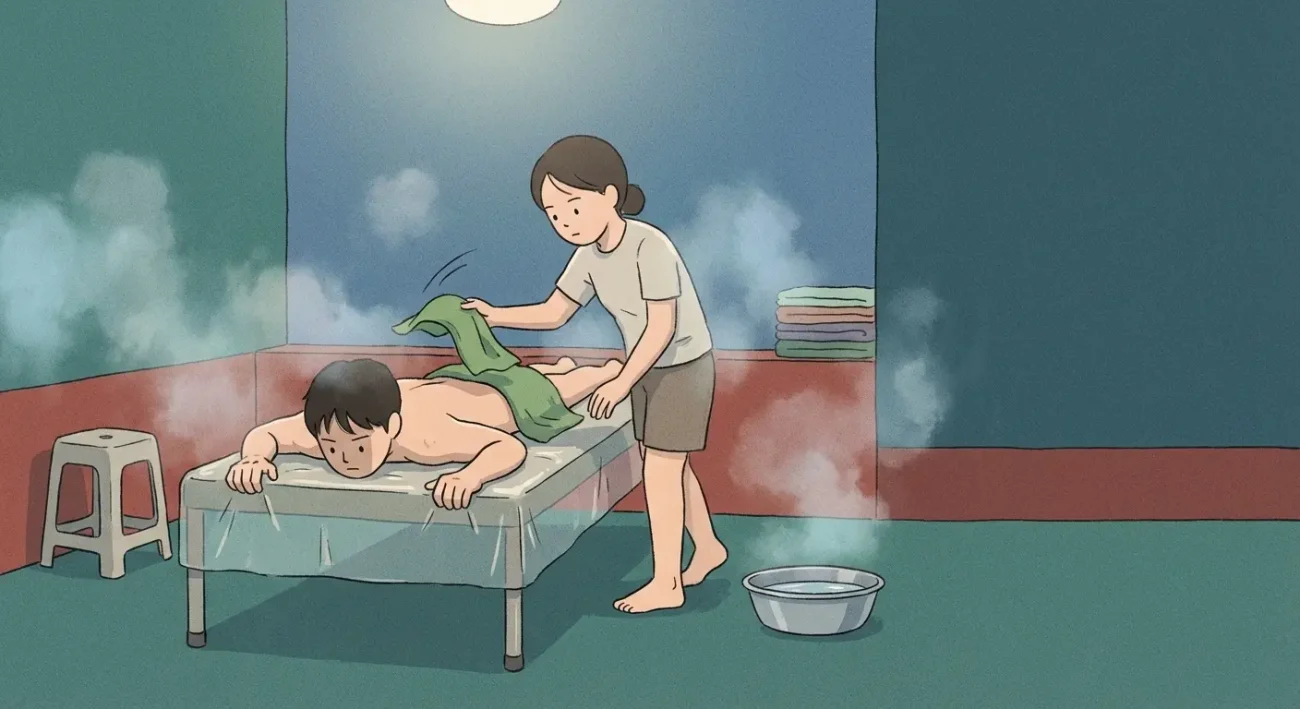
Every weekend of my childhood ended the same way: my mother’s hand on my shoulder, pulling me away from whatever I was doing in the bath, and her voice saying it was time. I would argue. I always argued. She was going to scrub me, and I knew from experience that she was not going to be gentle about it.
By the time she finished, my skin felt like it had been lightly sanded. I’d put my shirt back on and feel the fabric against my back in a way I hadn’t felt that morning — not painful exactly, but specific. Present. When I was small, she’d do my whole body. Later, when I was old enough to handle the rest myself, she’d take over only my back. Back then, it was only my back that hurt.
I’ve been thinking about this lately, because I keep reading questions from foreigners who find Korean culture fascinating, and the same question keeps coming up: Does that much dead skin really come off? My honest answer is — I’ve always wanted to ask the same question back. When you step out of the shower and dry off with a towel, has it never occurred to you that something might be coming off with it?
Why Is It Called an “Italy Towel”?
The name is the first thing that confuses people. It doesn’t look Italian. It doesn’t feel Italian. And if you ask most Koreans why it’s called that, they’ll shrug. I shrugged too, for most of my life.
The actual origin is oddly specific. In 1967, a textile manufacturer in Busan developed this scrubbing cloth using viscose rayon fabric imported from Italy. The material had exactly the right texture — rough enough to remove ttae (때, dead skin), flexible enough to work across the whole body. Production eventually moved to Korea, but the name never did.
What I find interesting is that most Koreans only learned this recently, through videos and articles that started circulating online. I found out myself while preparing to write this. For something so ordinary — something most of us have used since before we could reach our own backs — the backstory turns out to be genuinely surprising.
What Scrubbing Actually Feels Like
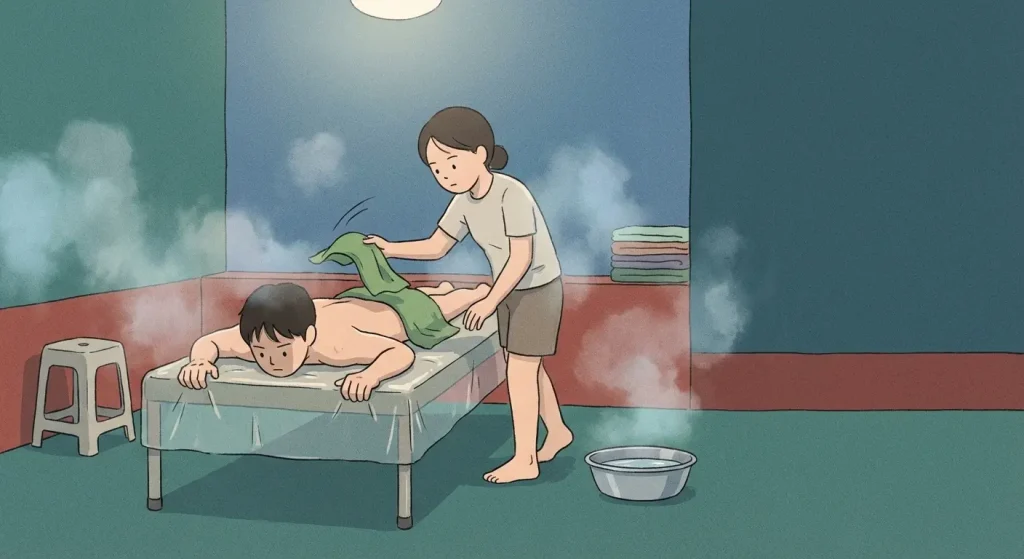
Before anything happens, you soak.
You sit in hot water longer than you usually would. Your body softens, your thoughts slow down, and there’s a point where you stop trying to think about anything in particular. That numb warmth is not accidental — it’s the preparation. The heat loosens the outer layer of skin, and without it, scrubbing wouldn’t do much. That’s why you wait.
Then comes the first pass of the towel, and it’s always sharper than you expect, even when you know it’s coming. The strokes are short and repetitive, and gradually — visibly — thin gray rolls begin to appear on the surface of your skin. If you’ve never seen this before, it’s startling. If you grew up with it, it’s just Saturday.
When it’s over, you rinse and apply body lotion. There’s a dryness that follows scrubbing — that part is real — but with lotion, the feeling afterward is something I’d call complete rather than clean. Like something that had been accumulating for weeks has finally been removed, and your skin can breathe properly again.
Not clean in the usual sense. More like finished.
The Person Doing It Is a Professional
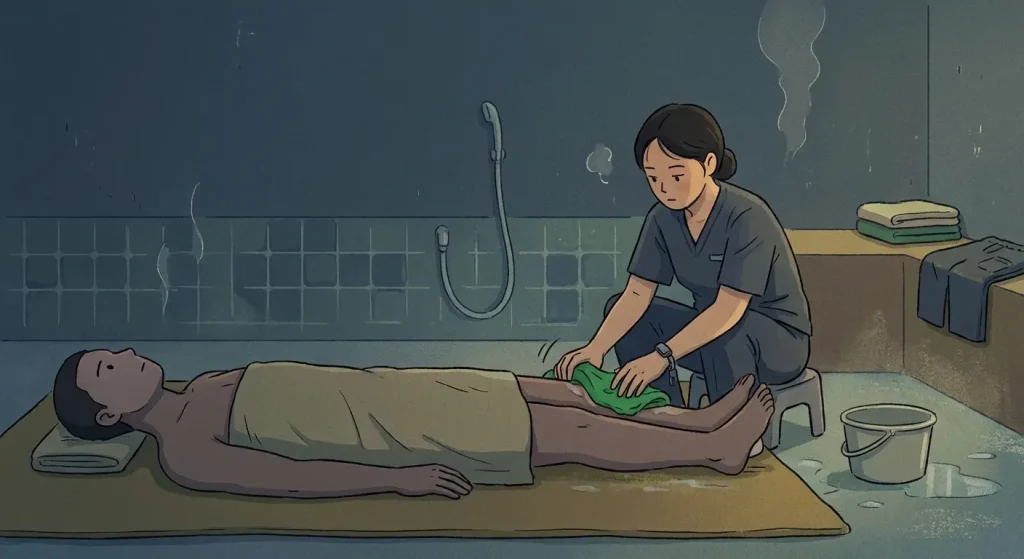
In most bathhouses and jjimjilbangs, there are professionals whose job is exactly this: seshinsa (세신사), body scrubbers by trade.
The process, once you know it, is straightforward. You enter, store your clothes in a numbered locker, shower, and then soak in the hot bath until your body feels ready. After that, you either find the seshinsa inside the bathing area or, if there’s no one there, step out and ask the staff near the locker area. They’ll often ask for your locker key. You hand it over, lie down on the vinyl table, and from that point, you don’t really need to do anything.
The service runs around 30,000 KRW for the full body. For a long time, the standard approach was to scrub yourself and only ask for help with your back — the part you can’t reach properly on your own. But these days, most people just hand the whole job over. It’s not laziness. Soaking in a hot bath long enough to properly soften your skin takes something out of you, and by the time you’re ready, you don’t always have the energy left to do it thoroughly.
There’s a brief moment of self-consciousness when the seshinsa works around more sensitive areas. That feeling passes quickly. After a few minutes, you stop noticing.
Why This Shows Up in Korean Dramas
In Korean dramas, you’ll occasionally come across scenes of friends or family scrubbing each other’s backs at a bathhouse, or returning home together after a trip to one — quieter than you might expect, not much said between them.
There’s something about bathhouses that changes the atmosphere between people, and I think it’s hard to explain to someone who hasn’t experienced it. You’re in the same warm room, doing the same thing, in a state where pretending requires more effort than it’s worth. Conversations there tend to feel more direct. Not more dramatic — just more honest. Less mediated.
That’s why these scenes keep appearing. The bathhouse is where reconciliation happens quietly, where families show closeness without ceremony, where friendships are confirmed without announcement. It’s not a symbol the writers invented. It’s something that people who grew up going to bathhouses actually recognize.
If You Want to Try It Yourself
There are two ways to approach this.
You can buy an italy towel and try it at home. They’re easy to find — inside bathhouses, at convenience stores, or online. A pack of five runs around 5,000 KRW. If your hands are on the larger side, it’s worth getting a bigger size. The method itself is simple: shower first, then soak in hot water long enough to soften the skin, slip the towel over your hand, press it against your skin, and scrub in short, repetitive strokes.
But the first experience is meaningfully different when a seshinsa does it. Not because the result is better, but because you understand the full rhythm of the thing — how long to soak, how much pressure is appropriate, when to stop. Trying it alone in a hotel bathroom gets the mechanics right but misses the context that makes it feel like what it actually is.
If you’re already planning to visit a jjimjilbang, it’s worth doing at least once.
The next time you see that green towel appear in a Korean drama — the scrubbing, the steam, the silence between two people who don’t need to say anything — it won’t look like an odd ritual anymore. You’ll recognize the rhythm of it. The soaking, the first sharp pass of the towel, the way everything feels lighter when it’s done. That part hasn’t changed at all. I’ve just been doing it long enough that I forgot it was ever something to explain.
