Someone posted a question in an online forum after watching a Korean drama. “The servants shouted ‘cheonse’ at the king’s coronation and suddenly Korean viewers were furious. I just thought it looked dramatic and impressive. What exactly is the problem?” I read that question and paused for a moment. The honest answer was: it was never about one word. And what that viewer missed went far beyond vocabulary.
What a Single Word Carries — Manse and Cheonse
In Korean history, when a king took the throne, his subjects called out manse (만세). This was not simply a cheer. Manse was the expression reserved for the ruler of a fully sovereign nation — a king or emperor who governed independently. Historical records from the Joseon dynasty show that when King Taejo, the founder of Joseon, was enthroned, his subjects called out manse. Joseon maintained diplomatic relations with Chinese dynasties, but within its own ceremonial space, the Korean king was a ruler who received manse. That was how Joseon understood itself.
Cheonse (천세) is an entirely different expression. Cheonse was used for the king of a tributary state — a vassal kingdom operating under the authority of the Chinese emperor. The emperor received manse. The subordinate king beneath him received cheonse. This was not a difference in enthusiasm or phrasing. It was a language that defined the political hierarchy between nations. A king who received manse and a king who received cheonse occupied completely different positions in the order of power.
In the 2026 Korean drama 21st Century Daegunn Buin, episode eleven showed a new king ascending the throne. The expression his subjects called out was cheonse. The drama had set itself in what it called the Republic of Korea — a fictional constitutional monarchy, a sovereign and independent nation. And yet, at the most formal and official moment in that sovereign state’s royal ceremony, the king received the language of a vassal kingdom. For Korean viewers watching that scene, this was not easy to pass off as a minor oversight. Even by the drama’s own internal logic, a self-proclaimed sovereign nation had chosen the vocabulary of subordination for its most defining ceremonial moment.
What the Crown Says — The Difference Between Twelve Strings and Nine
The royal crown carried its own message. In the ceremonial system inherited across East Asian dynasties, the emperor wore a sibiryumyeoryugwan (십이류면류관) — a crown with twelve hanging bead strings. The king of a tributary state wore a guryumyeoryugwan (구류면류관) — nine strings. The number was not decorative. It announced exactly where a ruler stood in the hierarchy of nations.
The drama positioned its king as the head of a self-governing sovereign state. By the internal logic of that setting, this king should have represented the highest authority in the land. After Korea formally proclaimed the Korean Empire in 1897, Emperor Gojong wore the twelve-string crown as a direct assertion of sovereign equality. That history was not obscure. Yet the crown worn in the drama’s coronation scene was the nine-string version — the crown of a vassal. In the same scene, the word used for the king’s death was holseo (홀서), the term for the passing of a feudal lord, rather than bungeo (붕어), the term reserved for an emperor.
Cheonse at the coronation. A vassal’s crown on the sovereign king’s head. A feudal lord’s death rite applied to the nation’s highest ruler. These three things appeared together, in the same scene, pointing in the same direction. One might be a prop oversight. Three, arriving together in the drama’s most ceremonially significant moment, did not feel that way to Korean viewers.
Historical Symbols in Kdramas — Raw Food and the Korean Royal Table
Korean royal culture had no prohibition against eating raw food. The historical record points the other way entirely. Documents from the Joseon court show that raw and fermented dishes were regularly present at the highest levels of society. Ganjang gejang — raw crab marinated in soy sauce — is one of Korea’s oldest preserved foods, enjoyed by both the royal court and aristocratic households. Mineo hoe, raw croaker fish, was considered among the finest seasonal delicacies of the Joseon period. Yukhoe, raw seasoned beef, holds a long and established place in Korean food culture. Eating raw food was entirely familiar in the Korean royal context. It was not a forbidden category. It was a celebrated one.
Chinese food culture developed along different lines. Stir-frying, steaming, and braising became central techniques in the Chinese culinary tradition. The avoidance of raw food is a recognized feature of that tradition — not a Korean one. The idea that royalty should abstain from raw food belongs to a different cultural framework entirely, one that does not appear in Korean historical records.
In 21st Century Daegunn Buin, a character stated plainly: “It is royal law that members of the royal family do not eat raw food.” Korean viewers who heard that line found themselves genuinely confused. This was not a rule they had encountered in school, in other historical dramas, in family stories passed down across generations, or anywhere in Korean cultural memory. The rule had no home in Korean history. Some Korean viewers found it difficult to explain that inclusion simply as a gap in research — particularly given the other elements that had already accumulated in the same direction.
The Tea Ceremony That Was Not Korean
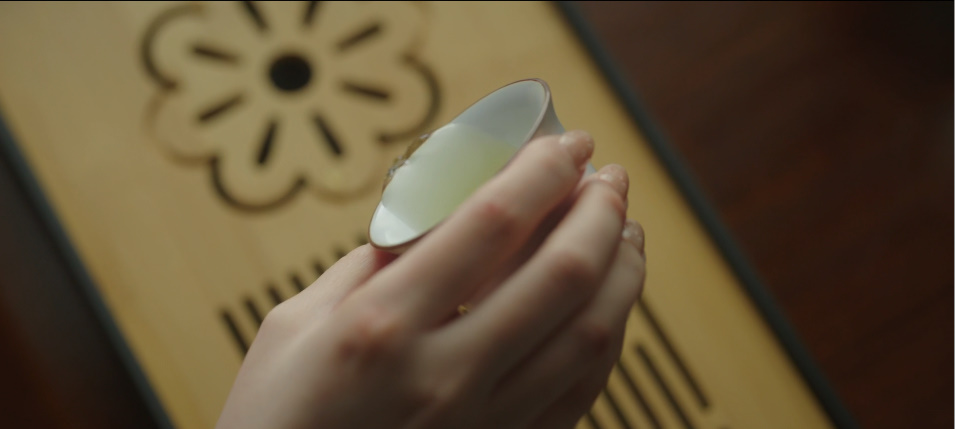
Korean traditional daerye (다례) is built on restraint and precision. When tea has been poured and water remains, it is emptied separately into a toesugi (퇴수기) — a dedicated vessel kept apart from the tea space. This separation is intentional. It keeps the ceremony clean, ordered, and physically distinct. Korean daerye developed through the layering of Buddhist tradition and Confucian ritual, and it has its own logic, its own tools, its own physical grammar that a practiced eye recognizes immediately.
Chinese dayeh (다예) works differently. In the Chinese style, the tea tray itself — the chaban (차판) — is designed to receive water directly. Water is poured over the tray’s surface and drains away through it. This is a recognized feature of Chinese tea practice, and it is visually distinct from the Korean method. Someone familiar with either tradition would not easily confuse the two.
In 21st Century Daegunn Buin, a scene showed two characters facing each other over tea — a formal encounter, staged with care and deliberate visual attention. The tea set used was Chinese. The water was poured directly onto the tray in the Chinese manner. The director later said in a post-finale interview that the tea scene carried no intended controversy, and that the choices came from a desire to create contrast between characters. Korean viewers, by that point, were no longer evaluating each element in isolation. The tea scene arrived inside a pattern that had already been taking shape, and they read it accordingly.
The Emblem on the Prince’s Robe — Girin and Baektaek
In the Joseon court, the emblem sewn onto a royal robe was not decorative. It announced rank with precision. The heungbae (흉배) — the chest emblem — was regulated according to a clearly defined system. For a daegun (대군), the king’s legitimate son born of the queen, the correct emblem was the girin (기린): a mythological creature symbolizing benevolence, peace, and legitimate royal authority. This was not open to creative reinterpretation. It was a defined and documented element of Joseon royal dress.
The baektaek (백택) is a different creature entirely. In Chinese mythology, the baektaek is a being said to know all the world’s secrets — and to reveal them only to the Chinese emperor. Its symbolic meaning is specifically tied to submission before Chinese imperial authority. Placing the baektaek on a Joseon royal robe was not simply unusual. The symbol carried a meaning that ran directly counter to the premise of a sovereign Korean royal lineage.
The emblem on the prince’s robe in 21st Century Daegunn Buin was the baektaek, not the girin. Korean viewers who noticed felt it was difficult to read simply as an accidental substitution. Whether it was oversight or not, a symbol whose mythology is defined by loyalty to the Chinese emperor had been placed where Joseon’s own royal insignia belonged.
A Title That Did Not Exist in Korean History — Daegunn Buin and Bubuin
In Joseon, the official title for a daegun‘s wife was bubuin (부부인). This is documented within the Joseon royal hierarchy. Joseon regulated the titles and ranks of every member of the royal family with considerable precision, and that system held throughout the dynasty. The title daegunn buin (대군부인) did not exist within it.
The form that daegunn buin follows — attaching the husband’s rank directly to buin — more closely resembles the title structure used in Chinese royal drama, where chinwang-gunwang-gunbuin hierarchies appear as standard vocabulary. In Korean history, the structure simply does not exist. Yet it became the title of the drama itself. A drama’s title is the first and largest piece of language its audience encounters. This one opened with a term that did not belong to the Korean royal vocabulary — a detail that many viewers returned to examine closely once the controversy had already begun.
When the Eldest Must Kneel — The Queen Dowager Scene That Broke Joseon’s Core Rule
Joseon was built on hyo (효) — filial devotion — as a governing principle, not merely a personal virtue. This applied inside the royal family as clearly as it did anywhere else in Joseon society. The daebi (대비), the queen dowager, held the highest position of authority among the living members of the royal household. As the mother of the former king and the senior figure of the entire royal family, her authority was not conditional. It did not yield to younger members of the court, including the reigning king. When a young king ascended the throne, it was the queen dowager who sometimes governed in his place through suryeomcheongjeong (수렴청정) — a formal system of regency. The king and his subjects all observed proper deference before her. That was Joseon’s order.
A daegun is the king’s son. The queen dowager stands above him in every dimension that Joseon recognized — age, family hierarchy, and royal protocol. No matter how much political influence a daegun might accumulate within the drama’s fictional court, Joseon’s Confucian framework placed the eldest above the younger without exception. This was not a rule that bent under circumstances. It was the foundation that the entire social and royal structure rested upon.
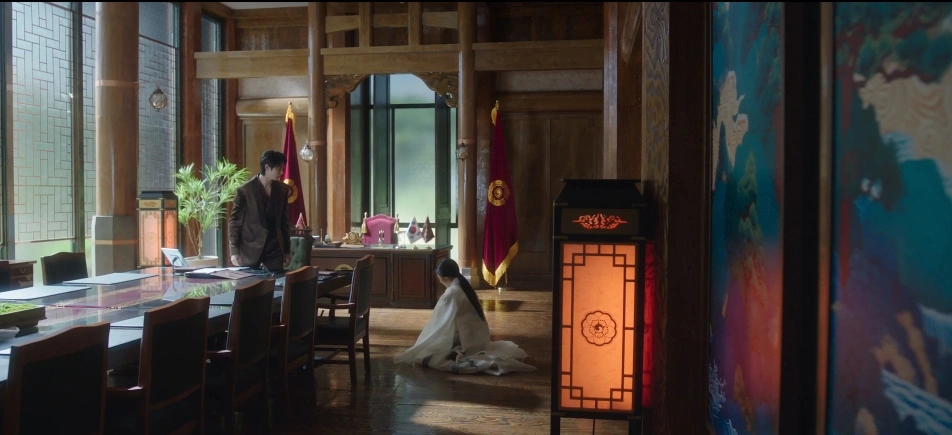
In 21st Century Daegunn Buin, there is a scene in which the queen dowager — the highest-ranking elder of the royal household — kneels before the daegun and performs seokgodaejoe (석고대죄), an act of prostrated apology. Korean viewers watching that scene did not simply find it unusual. What they saw was the complete inversion of Joseon’s most fundamental social order — the hierarchy of hyo and ye (예), of filial respect and ritual propriety, turned upside down in a single shot. It is worth noting that a structure in which a younger male royal holds authority above the senior female elder of the household does appear in certain historical contexts elsewhere in East Asia. Some Korean viewers raised the Japanese imperial structure as a point of comparison. The director stated clearly that Japanese royal customs were not referenced in the production. Where this particular dynamic came from, then, was a question that did not settle easily among those who had already been watching the other symbols accumulate.
What the Kings’ Names Say — The Pattern in the Posthumous Titles
In Joseon, when a king died, his ministers deliberated carefully before assigning his myoho (묘호) — the posthumous title by which he would be known to history. This title was meant to reflect the king’s character and reign. It was the final official judgment passed on a ruler’s life, decided through serious discussion.
21st Century Daegunn Buin released its own official royal timeline, mapping out the fictional kings of its invented dynasty. After the controversy surrounding the drama’s symbolic choices became widespread, some Korean viewers began examining this timeline closely — specifically, the posthumous titles assigned to its kings. What they found generated significant discussion online. A number of the titles given to the drama’s fictional Korean kings appeared to match the posthumous names of rulers in Chinese history who were known for leading their dynasties to ruin — kings associated with incompetence, moral failure, and national collapse. Titles such as Huijong, Uijong, and Gwangjong, among others, were matched by viewers to specific figures from Chinese dynastic history.
These observations represent viewer analysis and interpretation that spread through online communities following the controversy — not confirmed production decisions. Whether the overlaps were intentional, coincidental, or the result of limited research is not something this post can determine. What they reveal, regardless, is how thoroughly Korean audiences began examining every available detail of the drama once the first symbols had already been noticed. When trust erodes in this particular way, viewers do not stop at the scene that first troubled them. They go back to the beginning, and they look at everything.
Why Chinese Reactions Online Made Korean Viewers React More Strongly
While the controversy was spreading, a different set of responses appeared on international social media — and they landed hard.
One account wrote in English: “Korea was a tributary state of China for most of its history. They only became free at the end of the 1800s, and then immediately fell under Japanese and Russian influence before being annexed. Korean viewers are overreacting.” Another wrote: “If Koreans really dislike their vassal state history, why do they insist their emperor should wear twelve-string crowns and receive manse? That is the Chinese royal attire system.” A third account, writing in Chinese, argued that Korean viewers reject any drama acknowledging historical Chinese influence while claiming everything as independent Korean invention.
The logical error running through these responses is worth naming clearly. Manse and the twelve-string imperial crown were not inventions that China distributed to tributary states as a form of favor. They were the forms used by sovereign nations across East Asia to represent their own highest authority. Korea’s assertion of that form — formalized through the proclamation of the Korean Empire in 1897 — was precisely an act of claiming sovereign equality with the Chinese emperor, not of borrowing his customs. The controversy in 21st Century Daegunn Buin pointed in exactly the opposite direction: a drama that claimed to portray a sovereign Korea while consistently using the symbolic language reserved for subordination. The online responses took that reality and inverted it entirely, framing Korean viewers’ objections as a form of historical denial rather than historical knowledge.
To understand how Korean viewers experienced that inversion, it helps to sit with a comparison — not to place different histories on identical terms, but to make the emotional logic accessible across cultures.
A Comparison for International Readers
Imagine a French drama set in a fictional modern monarchy. It is a romantic story — beautiful costumes, grand ballrooms, a love between a commoner and a prince. The drama is popular internationally and streams across dozens of countries. But in the king’s coronation scene, the courtiers perform a ritual gesture associated specifically with France’s Nazi occupation. The crown worn by the king follows a form designated during the Vichy period. A ceremonial scene presents German-style formal customs as French royal tradition. The production team says it was a fantasy setting and that strict historical accuracy was not the priority.
Then a social media account posts: “France spent years under German administration anyway. Why are French viewers being so sensitive about symbols?”
That comment would not calm anyone down. It would become its own separate source of outrage — and rightly so. Not because French history and Korean history are identical. They are not. But because the underlying structure is recognizable: a drama embedding symbols associated with a period of forced subordination into a story that claims to celebrate sovereignty, while outside voices say “you were subordinate anyway, so what is the problem.”
Poland offers another frame. A drama set in a fictional modern Polish monarchy includes repeated visual references to occupation-era German symbols in its royal ceremonies. Polish viewers object. Online, responses appear: “Poland was divided between Germany and the Soviet Union during the war. German cultural influence was real. Why are they so sensitive?” Anyone who has spent time around Polish history can imagine how those words would land.
Korea experienced decades of Japanese colonial rule. During that period, the Korean language was suppressed, Korean names were replaced with Japanese ones, and Korean cultural identity was systematically targeted for erasure. Before that, Joseon navigated centuries of complex diplomatic relationships with Chinese dynasties while maintaining its own internal cultural sovereignty and political distinctiveness. The history of Korea is, in significant part, the history of fighting to remain recognizably Korean in the face of external pressure to become something else. Korean viewers carry that history. They know what it feels like when the language of subordination is placed inside a story that is supposed to be about standing upright. They recognize it quickly. They respond to it loudly. And when the response from outside is “you were subordinate anyway,” the anger does not diminish. It sharpens.
What Fusion Sageuks Can Change — And What They Cannot
Korean viewers understand what a fusion sageuk (퓨전 사극) is. They have watched dozens of them over many years. A contemporary royal family existing in the modern world. A commoner falling in love with a prince. Historical settings used as backdrop for romance and drama that prioritizes feeling over accuracy. None of this requires strict historical fidelity, and Korean audiences know that. The genre exists precisely because creative liberties are part of its appeal, and viewers accept that contract when they sit down to watch.
But there is a line that Korean viewers draw — and it is not about accuracy for its own sake. The line is this: do not present something from outside Korean culture as established Korean royal law. Do not fill the space where Korean tradition belongs with the customs of another country, and then label what you have placed there as Korean. Cheonse is not part of Korean sovereignty. The nine-string crown is not the symbol of a self-governing Korean king. Pouring water directly onto a tea tray is not Korean daerye. The prohibition against royalty eating raw food does not come from Korean court records. When these elements appeared in the drama not as inventions or creative departures but as the established customs of a fictional Korean court, what Korean viewers experienced was not a failure of historical accuracy in the usual sense. It was Korean cultural space being filled with content that consistently pointed somewhere else.
The director acknowledged in a post-finale interview that he had been “ignorant” and felt he had “fallen into a swamp” during production. The writer apologized for insufficient research in the process of applying Joseon customs to a contemporary setting. Their remorse appeared genuine, and the pressures of a shortened production schedule were real. The drama Joseon Exorcist was pulled from broadcast after just two episodes in 2021 when similar concerns arose about Chinese cultural elements appearing in a Joseon-era setting. Korean viewers remembered that precedent. When they began noticing a pattern in 21st Century Daegunn Buin, they were not encountering this kind of concern for the first time. They had seen it before. Which is why they recognized it faster, and responded more forcefully.
The question that continued to circulate after the apologies had been made was not about blame. It was about direction. Each of the elements viewers identified — the coronation language, the crown, the death terminology, the food prohibition, the tea ceremony method, the royal emblem, the title structure — pointed the same way. When someone falls into a swamp, as the director described it, the swamp still has a location. Korean viewers wanted to understand where that location was. That question did not resolve itself with the final episode.
It Was Not Sensitivity. It Was Memory.
Let us return to the question posted online. “The servants shouted cheonse at the coronation. Why did Korean viewers react so strongly?”
Historical symbols in kdramas do not arrive without weight. Cheonse is not just a different number. A nine-string crown is not just a slightly simpler design. Water poured onto a tea tray instead of into a separate vessel is not just a stylistic choice. For Korean viewers, each of these things carries a specific history — a history that explains exactly why each symbol means what it means, and why placing it in the wrong context registers as something more than an error.
When one symbol appears alone, it is a question. When several appear together, moving in the same direction, across the same drama, the question becomes harder to set aside. That is what Korean viewers experienced. Not one oversight. A pattern. And a pattern that landed inside a decades-long history of fighting to preserve Korean cultural identity against exactly this kind of erosion — the slow replacement of Korean symbols with symbols that say something else entirely, presented so naturally that a viewer who does not already know the difference might never notice.
The viewer who asked why Korean audiences reacted so strongly was not wrong to be confused. From outside a particular history, a drama is a drama. A word is a word. A crown is a crown. But from inside a memory in which language was used to erase identity, in which symbols were tools of subordination, in which the difference between manse and cheonse was the difference between standing as a nation and kneeling as a province — from inside that memory, nothing in that coronation scene was just a prop.
It was not sensitivity. It was memory.
What is the difference between manse and cheonse in Korean history?
Manse (만세) was the expression used for a fully sovereign ruler — a king or emperor of an independent nation. Cheonse (천세) was reserved for the king of a tributary or vassal state under Chinese imperial authority. Historical records show that even Joseon kings received manse within their own court ceremonies. Using cheonse for a king in a drama set in a sovereign Korea contradicts both historical practice and the drama’s own internal logic.
Why do Korean viewers pay such close attention to small details in historical K-dramas?
Korea experienced decades of Japanese colonial rule, during which Korean language, names, and cultural symbols were systematically suppressed. This history makes Korean audiences particularly alert to moments when Korean cultural space is replaced by symbols from elsewhere. What may look like sensitivity from outside is, for many Korean viewers, a form of cultural memory and recognition.
What is the difference between Korean daerye and Chinese dayeh?
In Korean traditional daerye (다례), leftover water is poured into a separate vessel called a toesugi (퇴수기), keeping the tea space clean and ordered. In Chinese dayeh (다예), water is poured directly onto the tea tray, which is designed to drain it. The two methods are visually distinct. Using the Chinese method in a scene set in a Korean royal court registers as a cultural mismatch to Korean viewers familiar with either tradition.
Was the drama 21st Century Daegunn Buin intentionally distorting Korean history?
The director and writer both issued public apologies, describing the issues as the result of insufficient research and rushed production rather than deliberate intent. The director stated he had been “ignorant” and felt he had “fallen into a swamp” during filming. Whether the accumulation of symbols was intentional is not for this post to determine. What is documented is that multiple elements — the coronation language, the crown, the tea ceremony, the food custom, the royal emblem — each pointed in the same direction, and that Korean viewers responded to the pattern as a whole.
Why does it matter if a fusion sageuk uses non-Korean customs?
Fusion sageuks are understood by Korean audiences to take creative liberties with history. The concern is not about strict accuracy. It is about the difference between inventing something new and presenting a foreign custom as established Korean royal tradition. When a drama states that Korean royalty follows a food prohibition that does not exist in Korean royal records — but does exist in Chinese food culture — Korean viewers experience that not as creative storytelling but as a substitution of Korean culture with something else. That distinction matters to an audience whose cultural identity has historically been a site of contestation.
