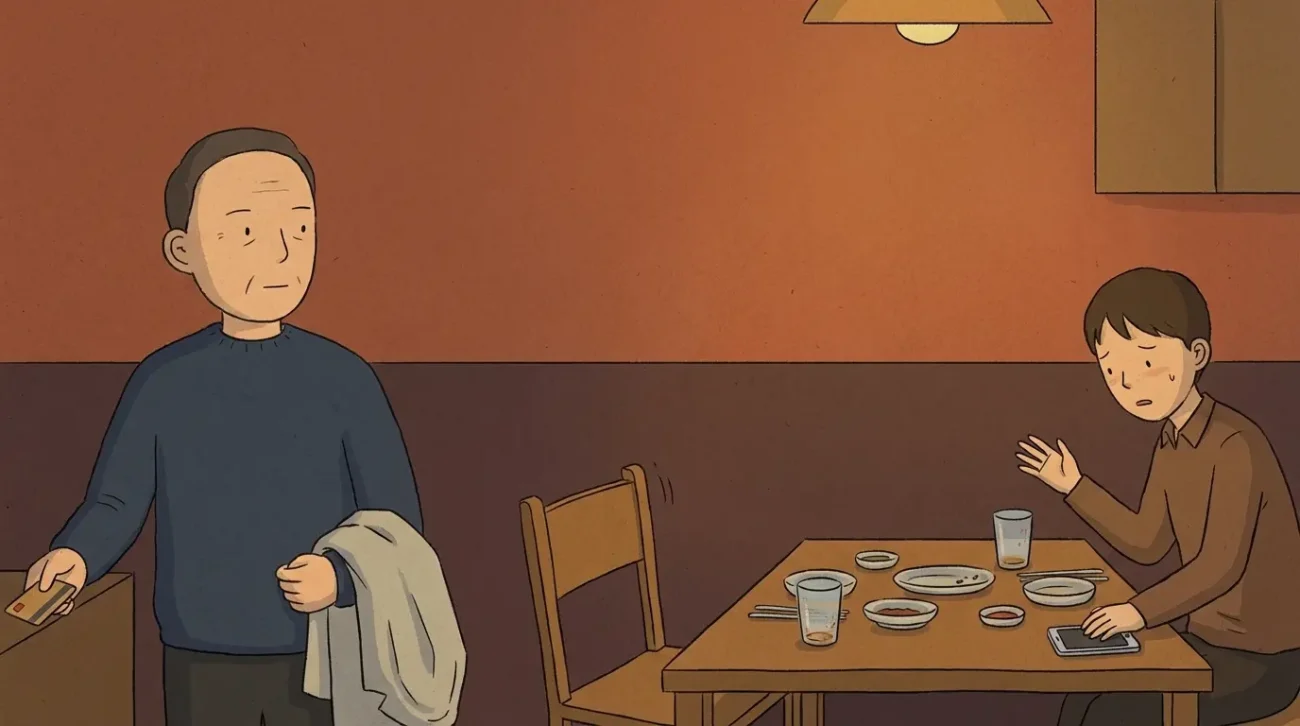
If you’ve ever watched a Korean drama and noticed someone suddenly excuse themselves to the bathroom, only to return having already paid the entire bill, that moment is real. The people still sitting at the table often do not know yet, so by the time they reach the cashier they are already pulling out cards, blocking each other, insisting, laughing, and getting strangely serious over who gets to pay.
That is usually the first point of confusion. Why does a simple restaurant bill suddenly become a small contest of speed, timing, and emotion? Why not just split it in half and go home? That question is exactly where the Korean bill fight stops being a joke and starts becoming a real cultural puzzle.
From where I stand, this scene is not really only about money. It is often about the feeling left behind by the meal. If the time felt warm, if the person across from me felt younger, closer, or worth treating, the bill becomes one last place where that feeling comes out.
Why Koreans Fight Over the Bill
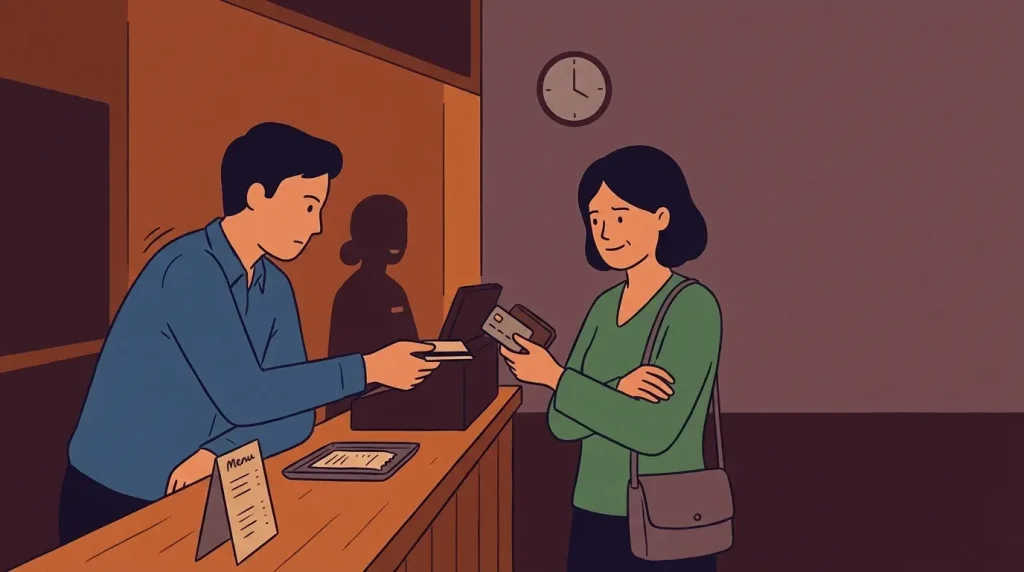
The tension is small, polite, and strangely serious. What looks like a money problem is really a relationship scene arriving at the cashier.
On the surface, the scene looks simple. Someone pays, someone protests, and the cashier gets dragged into the middle of it. But here, the bill often becomes the last emotional beat of the meal. It can carry chemyeon (체면, face), meaning the need to look generous rather than stingy. It can carry jeong (정, emotional bond), the soft feeling that builds between people over time. It can even carry naerisarang (내리사랑), the downward affection older people often feel toward someone younger.
That is why this is not just a payment method. It is a relationship scene.
I felt that very directly two months ago when I paid for a meal with a coworker. He worked with me, but he was also two years younger than I was, and I genuinely enjoyed that meal. Once that feeling came in, paying did not feel like obligation. It felt more like, I had a good time and I want to buy this younger colleague a meal. That is why, when I say Naega sseonda (내가 쏜다) — literally, “I will shoot,” but nobody’s getting hurt — I usually mean it. I am not testing the other person. I am saying I really intend to pay.
If someone reads that line as empty politeness, they miss the point. In many cases, the line is carrying real intent.
Is It Always One Person Who Pays?
This is where many first-time viewers get the wrong picture. No, we do not always avoid splitting the bill. A lot of the time, people do split it. If the situation calls for Dutch pay, they do Dutch pay. So the picture is not as simple as “one person always pays.”
The difference usually comes from relationship and life stage.
When I was in my teens and twenties, Dutch pay was much more common for me. We had less money. Part-time work did not give us much room. Splitting the bill kept things light for everyone. I felt less burdened, and my friends felt less burdened too. But later, when life became a little more stable and I had more room financially, something changed. If I had a good time with someone younger, or someone I felt close to, I started wanting to buy the meal instead.
That is why I do not see this mainly as a generation war. It looks more like a shift in room, comfort, and relationship. If the meal costs a hundred dollars, or much more, that becomes a different matter. But in ordinary situations, who pays often depends less on a rigid rule than on who feels moved to treat and whether the other person is in a position to comfortably accept it.
So yes, Dutch pay exists. So does treating. And in real life, both live side by side.
How Age, Affection, and Hierarchy Enter the Check
The pressure here is gentle, not hostile. The feeling is less “I must pay” than “I want this meal to end with me treating you.”
One of the biggest questions outsiders ask is why older people seem expected to pay. But even that is not as fixed as it first appears. I do not pay every time just because I am older. No one can keep doing that endlessly. It is not an automatic law.
Still, there is a slope to the culture. If I am even a year older, if the meal felt good, and if the person begins to feel like a younger sibling rather than just a random colleague, then buying the meal feels natural. It does not feel forced. It feels hard not to.
That emotional slope is where wigye (위계, hierarchy shaped by age and rank) quietly enters. It does not always show up as command. Sometimes it shows up as momentum. The younger person feels grateful but also a little burdened. The older person feels that letting the younger one pay would somehow leave the feeling unfinished. That is why the bill can suddenly become a small tug of war without anyone being angry.
I have seen this many times in middle-aged circles too. My mother meeting an old friend after a long time and both women trying hard to pay. My father’s friend’s family eating with ours and then the adults getting into a serious little struggle at the cashier. So the drama version is not invented from nothing. Real life is usually smaller and quieter than TV, but the emotional structure is recognizably the same.
And there is another case people keep asking about but do not say out loud until later: first dates and arranged introductions. In those settings, it is still more common for the man to pay first, though this is clearly changing. That older expectation has not fully disappeared, but it no longer feels untouchable either.
What If You’re the Foreigner at the Table?
This is where many people get nervous. If you are eating with a Korean friend, partner, or your partner’s family, is it rude to pay first?
From my perspective, no, it is not rude. But it can make the Korean person feel a little flustered. Not offended, just caught off guard. If I wanted to buy the meal for you and you paid before I could, the feeling is less “How dare you?” and more “You took away the chance I wanted.”
That is especially true if you came a long way to see me. If someone flew from another country to meet me in Korea, my instinct would be to buy the meal. In that case, if the other person paid first, I would probably feel sorry and slightly embarrassed, not angry. At the same time, I also know many people come from cultures where Dutch pay is completely normal, and that is understood here too. So if the relationship is still new, or if both people are early in working life and money is tight, splitting the bill may feel perfectly natural.
What changes the scene is closeness. Once I stop thinking of someone as “a foreigner” and start thinking of them as “my friend” or “my younger sibling,” the desire to treat can become much stronger. That is why there is no single rule here. The real question is not nationality. It is what kind of relationship the table already holds.
So if you are the foreigner at the table, the safest reading is simple. If the other person strongly wants to pay, receiving that kindly is not rude. If you genuinely want to offer, offer once naturally. Then read the temperature. That usually works better than trying to memorize a hard rule.
The Bill-Paying Tactics We Actually Use
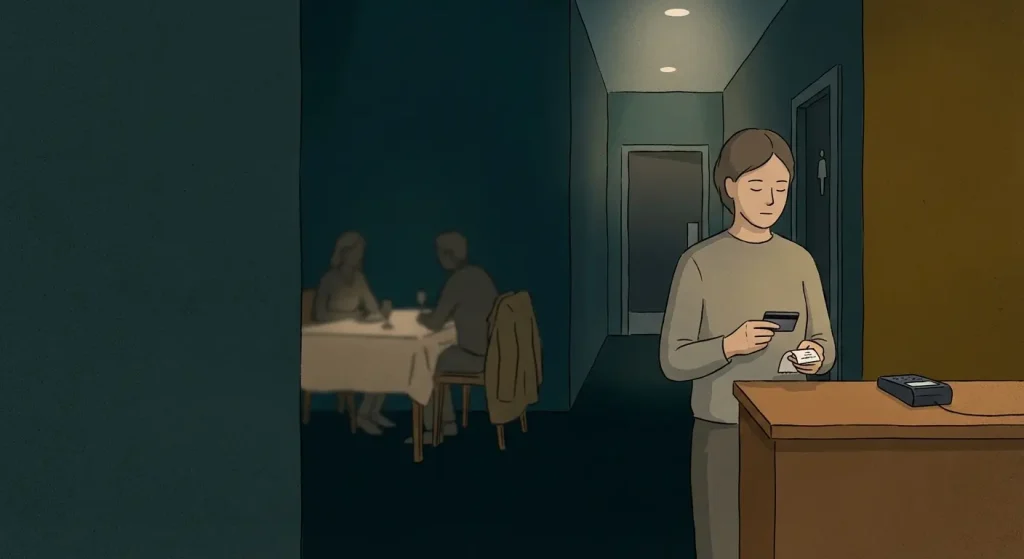
Nothing dramatic is happening, which is exactly why the tactic works. The whole move depends on looking ordinary until the surprise appears at the cashier.
Korean dramas love one specific tactic: the bathroom move. Someone casually says they are going to the restroom, and by the time they come back, the whole meal has already been paid for. That happens in real life too. Usually it is not fake. The person actually does go to the restroom and then pays on the way back. But yes, this tactic is common enough that it no longer surprises me.
There are also other tactics that look almost like games. In some office groups, when coworkers go drinking or eating together, everyone puts out one card and asks the restaurant staff to pick one at random. Whoever owns the chosen card pays. It turns the tension into play. Even there, though, newcomers are often exempt. The newest employee frequently gets left out of that random game, which tells you again that the bill is not only about money. It is also about place, timing, and social protection.
The funniest version is when three or more people eat together, one person has already paid while returning from the restroom, and the other two do not know. Then those two start arguing at the cashier over who should pay, only to find out the battle ended several minutes ago. I have been in that exact situation. Three of us went out to eat, and while I was arguing with another person over the bill, the third had already quietly taken care of it. When I realized, I felt embarrassed immediately. My first thought was not noble at all. It was, why didn’t the staff tell us it had already been paid?
That is the kind of scene Korean dramas exaggerate because it works so well onscreen. But the basic structure is very real.
Why No Tipping, But Always a Bill Fight?
For many outsiders, this is the strangest part. If people here care so much about who pays, why is tipping still so unwelcome?
From where I stand, the answer is simple. The service cost is already included in the food price. So I do not feel there is a reason for the customer to add another layer on top. Here, you press the table bell and the staff usually comes quickly. Food is brought, the table is cleared, and the service is part of the place. So to me, tipping feels more unusual than a bill fight.
That is why I do not place tipping and bill struggles in the same category. The bill struggle is about relationship. Tipping is about labor cost structure and what part of that the customer is expected to carry. Those are very different questions.
That difference became especially visible when some platforms and restaurants started testing tip-friendly features in recent years. People reacted strongly against it. Complaints spread online, some businesses backed down, and in some cases the attempt itself became a reputational problem. So even though the Korean bill fight can look dramatic, it does not mean this is becoming a tipping culture. Those are separate cultural instincts.
If anything, the contrast makes more sense from inside the culture than outside it. Paying for someone says, “I want to treat you.” Tipping says, “I need to add extra payment to complete the service.” Those simply do not feel like the same gesture.
If you go back to that drama scene — the sudden bathroom trip, the card already swiped, the two people still arguing at the cashier — it starts to look different once you know what is underneath it. Not just money. Not just manners. A little chemyeon, a little jeong, some wigye, sometimes naerisarang, and more than anything, a meal that did not end when the food did.
Is it rude to ask for Dutch pay in Korea?
Not really, though the answer depends on who is sitting across from you. If the other person is a close friend and the meal was relaxed, suggesting Dutch pay is usually fine. Where it gets complicated is when there is an age gap, or when the meal carried a certain warmth that the other person clearly wanted to close by paying. In those cases, insisting on splitting can feel less like fairness and more like pulling away from the feeling the meal just built. From my experience, reading that temperature — whether the other person is in treating mode or not — matters more than following a fixed rule.
What does “Naega sseonda” actually mean?
Literally, it means “I will shoot.” Nobody is getting hurt. In Korean, the word for treating someone to a meal borrows from the image of firing — sending something out toward the other person. When I say Naega sseonda (내가 쏜다), I am not being poetic. I am saying, clearly and directly, that I intend to pay. The phrase tends to come out before the meal ends, sometimes before it even starts, which is part of why the bathroom move works so well. By the time anyone realizes what happened, the shooting is already done.
Do younger people still follow the older-person-pays rule?
Less automatically than before, but the slope has not disappeared. What has changed is the room to push back. Someone in their twenties today is more likely to insist on splitting the bill with an older friend than someone the same age would have been fifteen years ago. Dutch pay has become more accepted, especially among people who met through work or school rather than through family or long shared history. But once jeong (정) enters — once the relationship stops feeling transactional — the desire to treat tends to come back regardless of generation. The rule has softened. The instinct behind it is slower to change.
What should I do if my Korean host insists on paying and I want to contribute?
Offer once, naturally and without pressure. If they decline, receive it graciously. Pushing back a second or third time can turn the moment awkward in a way that was not intended. The cleaner move, if you want to balance things out, is to find another occasion — coffee afterward, dessert somewhere else, the next meal. The way I think about treating is that it rotates over time, not something that has to be settled at every single cashier. Leaving the door open for next time is usually more comfortable for everyone than turning one meal into a negotiation.
Why do we fight over the bill but strongly resist tipping?
Because they are answering two completely different questions. The bill fight is about relationship — who gets to express warmth, closeness, or seniority through the act of paying. Tipping is about labor cost structure — whether the customer is expected to supplement a worker’s wage on top of what the restaurant already charges. To me, those are not the same gesture at all. The service is part of what I paid for when I ordered. Adding extra on top of that feels like correcting an invoice that was never wrong. The bill fight, strange as it looks from outside, comes from a completely different place.
