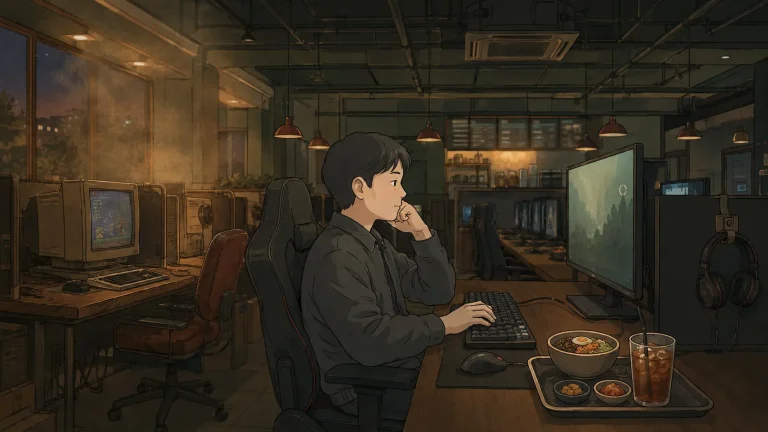
Korean Military Service: Why Every Korean Man Disappears for 18 Months
There is a number every Korean man carries with him from childhood. Eighteen months. No matter who you are or what you do, if you are a Korean man, this number will find you.
I knew about it by the time I was four. My male cousins started disappearing, one by one. Back then, the mandatory service period in Korea was three years. At some point, the cousins who had been absent began showing up at our house occasionally — in uniform, briefly, before vanishing again. That was when I understood where they had gone. In Korea, if you are born male, you go to the military. Barring exceptional circumstances, there is no alternative. This is not just social pressure. It is the law.
A Country That Never Officially Stopped Fighting
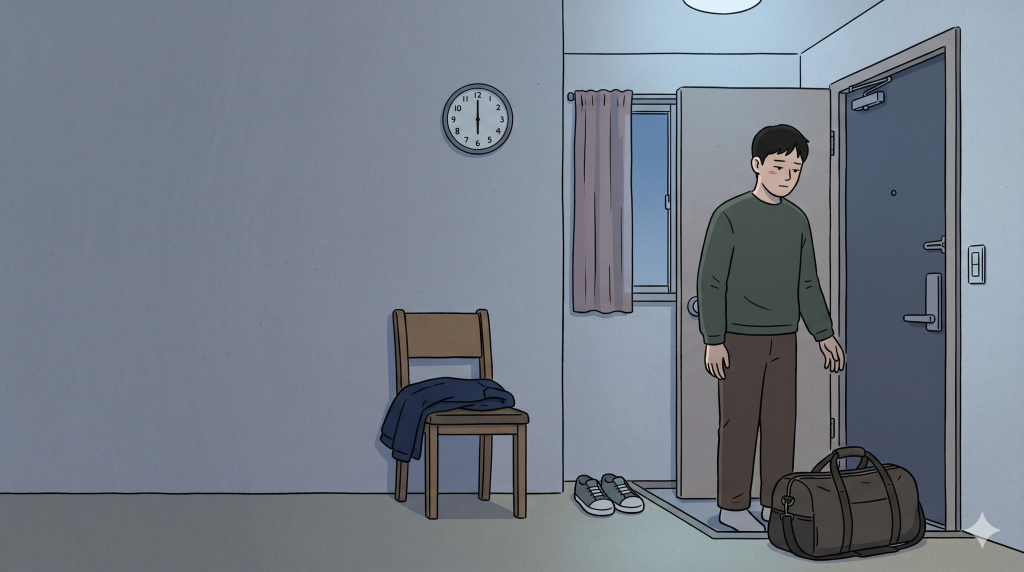
To understand why Korea requires military service of every man, one fact has to come first. Korea is a country where the war never officially ended.
The Korean War began in 1950 and stopped in 1953. But it did not end — it was suspended. What exists is an armistice agreement, not a peace treaty. That agreement is still in effect today. Since the ceasefire, North Korea has developed nuclear weapons, and missile tests appear at irregular intervals, just often enough that no one forgets they are happening. Russia and China — countries that share an ideological framework with North Korea and could justify lending support — sit within close geographic range of the Korean peninsula.
Koreans carry the memory of that war. A war between the same people, speaking the same language, pointing weapons at each other. That must never happen again. But the logic of preparedness has not changed. If the north were to move south again, South Korea would need the capacity to hold until outside support could arrive. That is why every able-bodied Korean man is required to serve. The threat is not abstract — it is written into the geography and history of the country.
Recently, with Korea’s younger population shrinking, some voices have begun to argue that women should be included in mandatory service as well. No conclusion has been reached. But the fact that the conversation has started says something about how seriously this country takes its military obligations.
The Man Who Comes Back Different — For a While
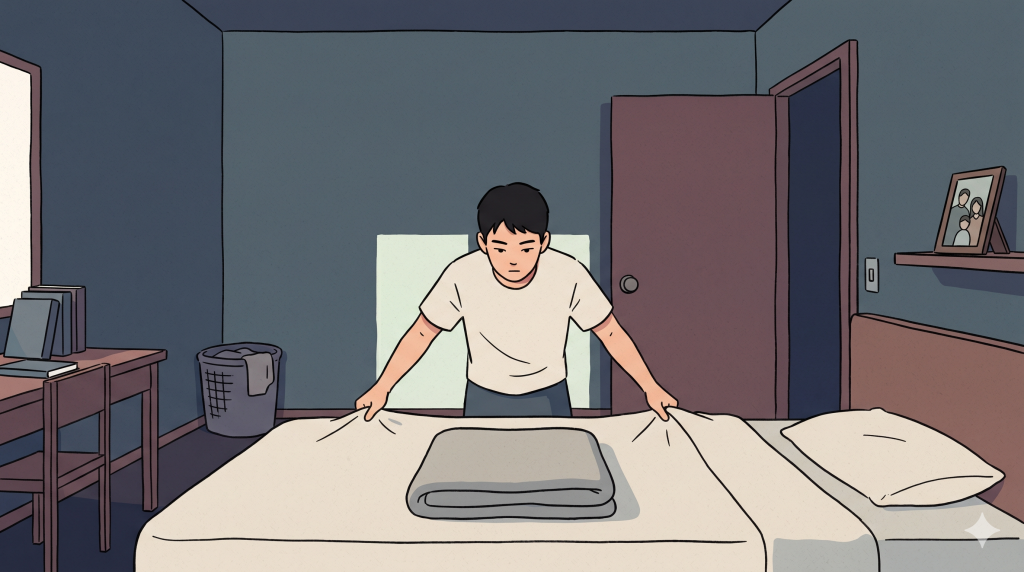
A man who has been through military service comes back changed. At least for a while.
The cousin who used to stay out all night came home and went to bed by ten for months. The one whose room had always looked like a minor disaster arrived back and made his bed every morning with the sheets pulled tight. The rhythms of military life followed them home. Something else changed too — cousins who had previously lived only for their friends suddenly had more patience for their parents. More consideration. Three years apart from family has a way of clarifying what matters. Watching those changes, I understood for the first time that military service does something to a person.
But the changes did not hold forever. Gradually, the old habits returned. Rooms got messy again. Bedtimes drifted later. The careful attention toward parents softened back into the ordinary friction of family life. The version of themselves that the military had shaped slowly gave way to the version that had existed before.
That is what I observed as a child. In adult working life, something more subtle becomes visible — a certain quality that distinguishes men who have served from those who have not. It is difficult to name precisely. It shows up in posture, in how they handle structure, in something behind the eyes. It is real, but it resists description.
Military service changes a man. Just not completely. When I was young, the service period was three years. By the time men my age were enlisting, it had come down to twenty-four months. Now it is eighteen. Long enough to leave a mark — not quite long enough to overwrite a lifetime of habit.
The Girlfriend Who Stopped Waiting — Gomushin
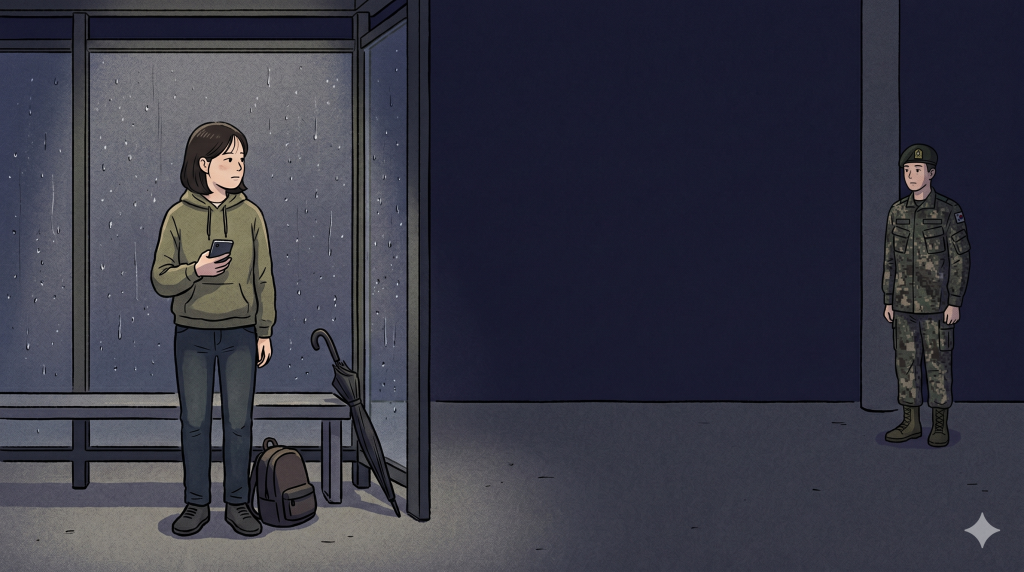
How many girlfriends actually wait for a boyfriend who has enlisted? In my twenties, when the service period was still twenty-four months, the answer was: almost none. Fewer than one in ten, by most accounts. The rest started new relationships while their boyfriends were away. That was simply the reality.
Korea has an expression for this. Gomushin geokuro shineotda (고무신 거꾸로 신었다) — literally, “she put her rubber shoes on backwards.” Gomushin are traditional Korean rubber shoes, the kind that have a clear front and back. Worn correctly, they point you forward. Worn backwards, you are facing the wrong direction — walking away from where you should be going. The expression captures exactly that: a woman who was supposed to wait has turned around and walked the other way. A woman who has a boyfriend in the military is simply called a gomushin. It is a word that manages to be both wry and a little sad at the same time.
The weight of military service extends well beyond the relationship question. When a Korean family is considering a marriage, one of the first things the bride’s father asks is whether the prospective husband served — and if so, where. This is not small talk. It is a way of reading the man’s history all at once.
If he did not serve, there is always a reason. Either the family circumstances were severe enough to warrant exemption, or there was a health issue. Actor Jo Jung-suk, for example, was exempted because his family’s financial situation was so difficult that his absence would have endangered their ability to survive. A father hearing that kind of explanation, from a man whose circumstances have since improved, is unlikely to hold it against him.
But if the exemption came from a medical or psychiatric history, the calculation changes entirely. A father thinking about his daughter’s future will weigh that information carefully. What looks like a bureaucratic record becomes something else — a window into a man’s health, his family’s circumstances, and the kind of life he has lived. Military service is not just a line on a resume. In Korea, it is one of the clearest ways a person’s past becomes legible to someone who has never met them before.
The Man Who Promised — and Then Didn’t
The most sensitive military question in Korea is not whether someone served. It is whether they kept their word.
In the late 1990s, there was a singer named Steve Yoo — known in Korea as Yoo Seung-jun — who had emigrated to the United States as a child but built his career in Korea. On television, in interviews, repeatedly and with apparent sincerity, he said: “I will definitely serve. I plan to enlist in the Marine Corps.” Then, quietly, he obtained American citizenship. As a dual national who chose the American passport, he was no longer required to serve in the Korean military. When he later attempted to return to Korea, he was denied entry. That ban has remained in place ever since. He has not set foot in Korea in decades.
When BTS’s military service became a public question, some Korean voices suggested that men contributing so much to the country’s global standing deserved an exemption. That argument nearly damaged public sentiment toward the group more than it helped. For Koreans who remember what happened with Yoo Seung-jun, the subject of exemptions carries a particular edge.
Celebrities and politicians’ children who manipulate medical records to avoid service — and are later exposed — face consequences that go beyond legal penalties. Singers lose their stages. Actors lose their roles. Politicians’ careers end. The principle is consistent: in Korea, no level of fame or influence is understood to place a person above the obligation that every ordinary man fulfills without recognition.
The 18 Months Nobody Gives Back
The hardest part of military service is not physical. The hardest part is what stops while you are away — and what does not wait for you to come back.
The early twenties are when the brain is at its most receptive. New information absorbs quickly, patterns form easily, and the work of building expertise compounds fastest during these years. This is also the period when Korean men are sent to serve. For eighteen months, the textbooks close. The subjects they had been studying — engineering, medicine, law, design, whatever they were building toward — go untouched. When they return and open those books again, the material that once felt familiar can seem like something encountered for the first time. Eighteen months is long enough to make knowledge go soft at the edges.
There is another kind of loss that is harder to measure. The early twenties are also the years when friendships are at their most alive — when groups of friends are traveling together, staying up through the night talking, accumulating the shared experiences that define a generation. While a man is in uniform, that accumulation continues without him. He returns to find conversations full of references he does not recognize, memories he was not part of. The circle closed a little while he was away.
There used to be a system that acknowledged this sacrifice. Men who completed their service received bonus points on civil service examinations — a modest form of compensation for the time given. That system was abolished on the grounds that it created gender inequality. Today, Korean men in their twenties give eighteen months to the state and receive nothing in return. No points, no compensation, no equivalent recognition. The job market does not pause. Peers who were not required to serve accumulate credentials, internships, and experience during those same months. A man returning from service does not step back onto the same starting line. He steps back into a race that has been running without him.
The Number That Never Goes Away
The number I first learned at four years old stays with Korean men for the rest of their lives.
It begins as something vague and distant — a fact about the world that does not yet feel personal. In the late teens it sharpens into reality. In the early twenties it becomes experience. And then, after discharge, it turns out that the obligation is not entirely finished. Until a man reaches his forties, he is required to attend reserve forces training — yebigun (예비군) — on a regular basis. The uniform comes back out. The drills resume. The military does not fully release its claim on a man just because his active service is over.
After that comes the rest of life, in which the question follows. In job applications. In marriage conversations. “Did you serve?” The eighteen months pass. The mark they leave does not. It appears on paperwork, surfaces in family meetings, and sits quietly in the background of decisions that seem to have nothing to do with the military at all.
If you have watched a Korean drama and noticed that a male character suddenly disappears from the story — and returns changed, older, slightly harder to read — you have seen this number at work. Eighteen months. Every Korean man who has ever lived through it knows exactly what that means. And every Korean woman who has waited — or stopped waiting — knows it too.
Is military service mandatory in Korea?
Yes. Military service is mandatory for all able-bodied Korean men. The current active duty period is approximately 18 months, though this has varied historically — from three years in earlier decades to 24 months more recently.
What happens if a Korean man doesn’t serve in the military?
Exemptions exist for severe health conditions or extreme family hardship, but they are scrutinized closely. Attempts to avoid service through fraudulent means — particularly by public figures — have ended careers and, in some cases, resulted in permanent bans from entering Korea.
What does gomushin mean in Korean military culture?
Gomushin refers to a woman whose boyfriend has enlisted. The phrase gomushin geokuro shineotda — “wearing rubber shoes backwards” — describes a woman who stops waiting and begins a new relationship while her boyfriend is serving. It reflects how difficult the waiting period has historically been for couples.
Do Korean men have military obligations after discharge?
Yes. After completing active duty, Korean men are required to participate in reserve forces training (yebigun) until their forties. Active service ends, but the military connection does not disappear entirely for many years afterward.
Why is BTS’s military service such a big deal in Korea?
Because the principle of equal obligation runs deep in Korean society. When exemptions for celebrities are proposed — even for those who have contributed significantly to the country — many Koreans respond negatively. The memory of public figures who avoided service and faced permanent consequences makes this a particularly sensitive topic.