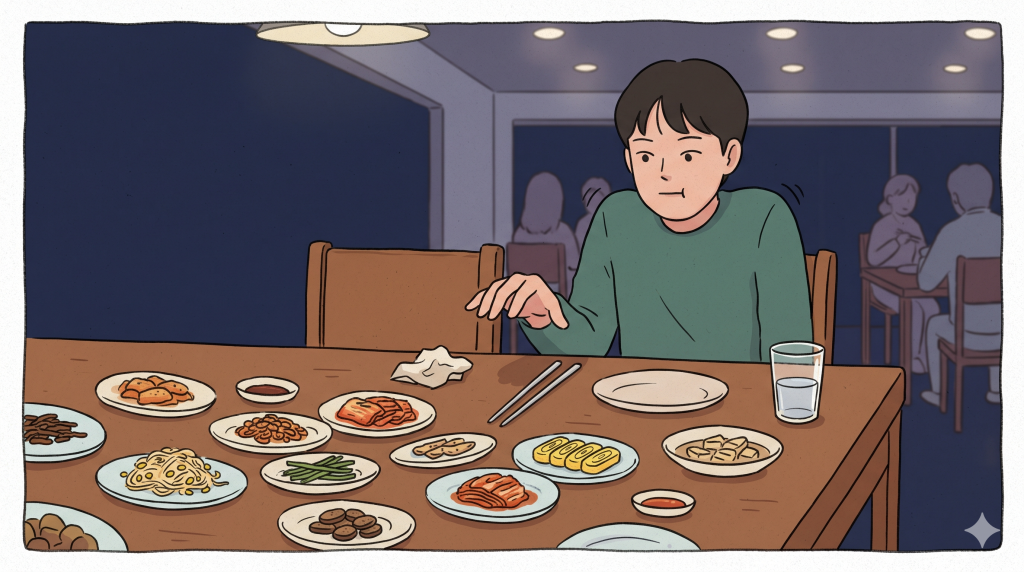
Have you ever sat down at a Korean restaurant, hadn’t ordered a single thing yet, and watched the table slowly fill up with small dishes anyway? You start counting the bowls. You wonder if someone made a mistake. I’ve seen that look on foreign visitors’ faces — the slight panic, the quick glance around to see if this is normal. For me, it’s always been normal. Those small dishes are banchan (반찬), and without them, it wouldn’t be a meal.
A Table Without Banchan Is Not a Table
In most parts of the world, a meal can stand on its own. A pizza is complete as it is. Whether you shake chili flakes over it or not is a personal choice — the meal works either way. A steak arrives and the meal is done. The potatoes on the side are optional. Take them or leave them.
In Korea, the logic is different. If there is no banchan, what’s left is plain rice. Just rice — slightly sweet, nothing else. A restaurant that served only rice with nothing alongside it would have no reason to exist. For Koreans, banchan is not a side. It is the condition under which a meal becomes a meal.
This is why the first moments at a Korean restaurant can feel disorienting for a foreign visitor. The order hasn’t been placed yet, but dishes keep arriving. “Is this all for me?” “Do I pay extra?” “Am I supposed to finish all of this?” The answers are simple. Yes, it’s all for you. No, there is no extra charge. And no, you don’t have to finish it — if you want more of something, just ask.
Banchan refills are standard at Korean restaurants. I’ve asked for more of a dish I liked, and I’ve also told servers to take back a dish I knew I wouldn’t touch. That’s how it works. Banchan moves freely across the table, and no one keeps score.
The Lunchbox My Mother Packed
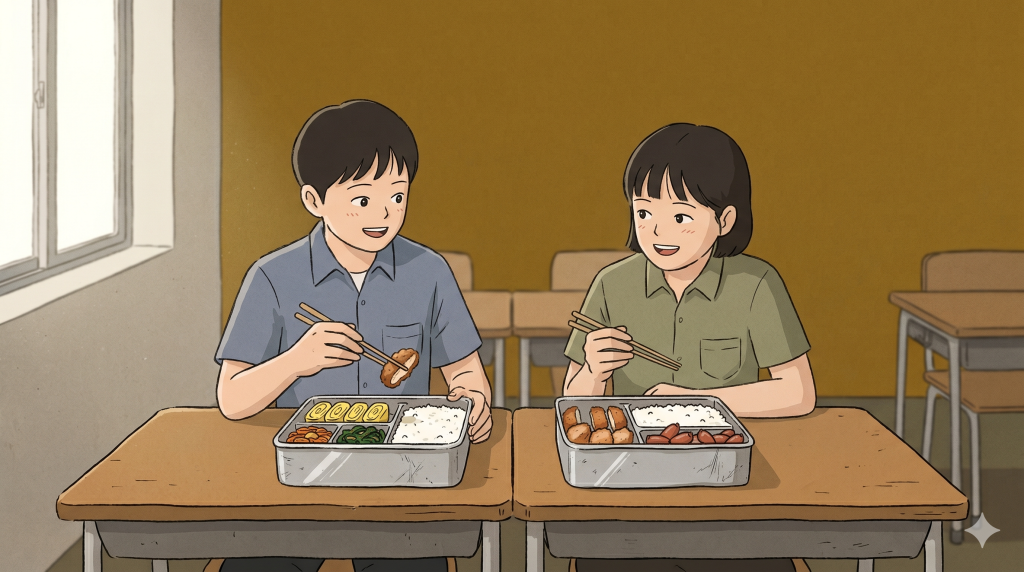
I grew up in a generation that brought lunchboxes to school. Every morning, my mother packed a small box with rice and whatever banchan she had prepared. My favorites back then were ham or small pork cutlets with ketchup — simple, nothing refined about it, but somehow exactly right. Looking back, I think what made those lunches taste so good wasn’t the food itself. It was eating them with friends, lunchboxes open side by side, sharing whatever looked interesting in someone else’s box. That small act of sharing was probably where my sense of Korean food culture began.
Making banchan at home is not simply a cooking task. It is the way Korean mothers express care through their hands. Banchan can be made quickly, yes — but it’s also genuinely time-consuming to think about. Every day requires something different. If spinach was on the table yesterday, today needs to be something else. Standing in front of the refrigerator each morning and figuring out what to make — that daily problem of deciding — is its own kind of weight. The effort and the daily planning, carried without complaint: that was the way Korean mothers did it. Open a Korean refrigerator and you’ll find rows of small containers lined up on the shelves. That image, for many Koreans, is what home feels like.
Younger generations have moved in a different direction. Delivery food and convenience meals have become the norm, and fewer people are making banchan from scratch. But there’s a particular quality that gets lost when food comes from restaurants and delivery apps every day. Restaurant banchan tends to be consistent — the same dishes, the kind that can be made quickly and easily, without much variation. The sheer variety that a home kitchen produces just doesn’t translate. People who eat out regularly may gradually forget what certain banchan taste like. They may never encounter the ones that require more time or care to prepare. And perhaps that is why, for many Koreans, the longing for home-cooked food runs so deep. It’s not just the taste. It’s the variety — the way the dishes on the table changed from day to day, depending on the season, the market, and whatever the person cooking had decided that morning.
Kimchi — The One That’s Always There
Whether kimchi counts as banchan is a question that makes Koreans pause.
It is banchan. But it is also more than that. Kimchi is the most fundamental item on a Korean table — the one constant while everything else changes. On a day when many good dishes are laid out, you might find that you reach for the kimchi less often. Something else is more interesting. But if the kimchi isn’t there at all, the table feels incomplete. Not wrong, exactly — just missing something essential. That feeling is difficult to explain precisely, but most Koreans recognize it immediately.
Kimchi jjigae (김치찌개) — kimchi stew — is made with kimchi as its main ingredient. A pot of it, made from well-fermented kimchi, can anchor an entire meal on its own. But here is the part that tells you something about what kimchi means in Korea: even when kimchi jjigae is on the table, kimchi also sits alongside it as a separate banchan dish. The stew contains kimchi. And then there is also just kimchi, as itself, next to the stew. That detail, small as it seems, says more than any explanation could.
Some Europeans apparently find it amusing to point out to Koreans: “You eat kimchi every day, don’t you? You probably have a whole storage room just for kimchi.” If this is meant as mockery, it doesn’t land the way it might be intended. A Korean hearing this is more likely to think: “This person actually knows something about us.” Because both things are true. Kimchi is eaten daily. And the kimchi refrigerator (김치냉장고) — a separate appliance designed specifically to store kimchi at the right temperature — exists in a large number of Korean homes. A country that invented a dedicated appliance for one food. That’s kimchi. That’s Korea.
Spring Cucumber, Winter Kimchi
Korea has four distinct seasons, and the banchan on the table changes with them.
Right now, cucumbers are in season — available everywhere, inexpensive, at their best. So oi sobagi (오이소박이) appears frequently: small cucumbers salted and stuffed with seasoned filling, crisp and cool. In summer, yeolmu kimchi (열무김치) takes over — a light, refreshing kimchi made from young radish greens, the kind that goes perfectly with cold noodles on a hot afternoon. Winter brings gimjang kimchi (김장김치), the large batch made in autumn when families gather to prepare enough kimchi to last through the cold months. And in spring, briefly, dallae muchim (달래무침) appears — wild garlic greens, simply seasoned, placed on top of a spoonful of rice. It tastes like the season it came from.
The rotation of banchan through the year is not just a matter of what happens to be available. It is the way Koreans experience the passage of time at the table. When oi sobagi shows up, summer is approaching. When dallae muchim appears, spring has arrived. Banchan is a kind of calendar — one that runs on what’s growing, what’s in season, and what the person cooking decided to make that morning.
The Real Way to Eat Banchan
There is no fixed sequence to a Korean meal. Eating a bite of rice, then a piece of banchan, then more rice — that’s not wrong. But it misses something.
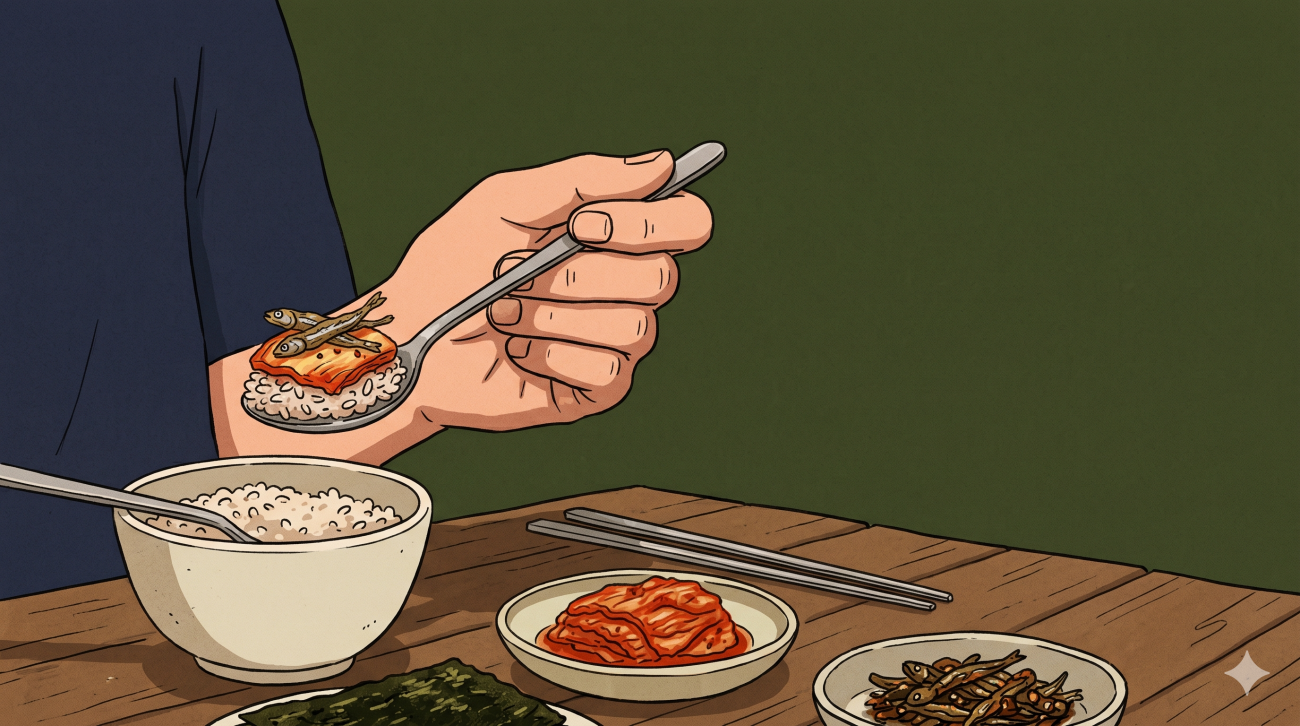
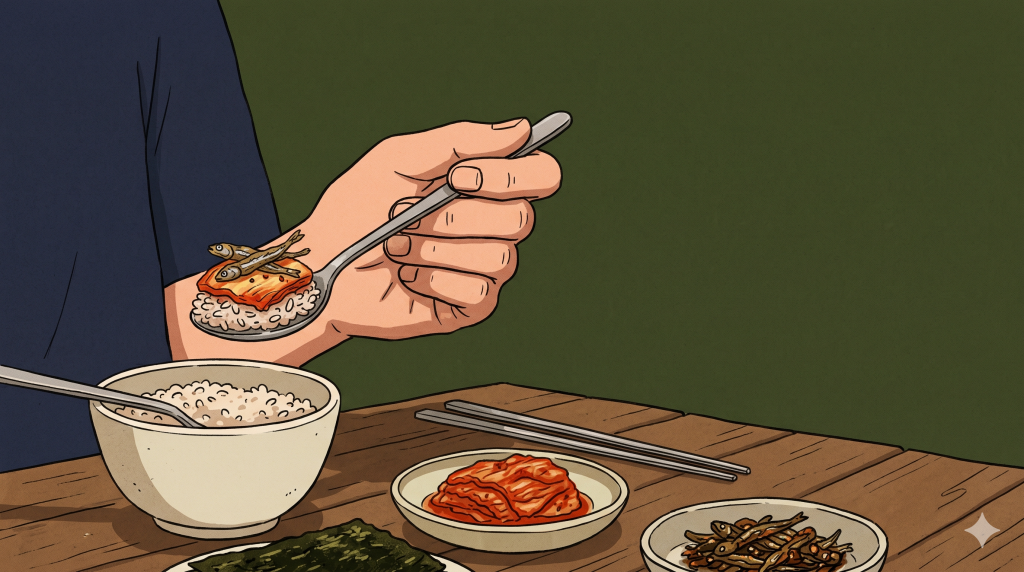
The real pleasure of a Korean table is in the combinations. A spoonful of rice followed by a bite of kimchi while also picking up a small dried anchovy. A ladle of kimchi jjigae paired with a piece of rolled egg. Rice wrapped in a sheet of dried seaweed, then a small bite of kimchi alongside it. My father used to discover these combinations and announce them to whoever was at the table. “Try wrapping the rice in gim and eating it with kimchi. It’s good.” And he was right — it always was.
What foreign visitors often miss is this: the banchan dishes on the table are not meant to be eaten separately, one at a time, as individual items. They are designed to work together, in combinations that shift with every bite. There is no correct version of this. The point is to explore — to find what works for you, at that table, with whatever happens to be in front of you. That process of discovery is part of what eating in Korea means.
The first time you sat down at a Korean restaurant and watched those small dishes arrive before you had ordered anything — maybe that moment felt strange. Now that you know where they come from and what they’re for, perhaps the next time will feel different. Put something on your rice. Add something else alongside it. Find your own combination. There are no wrong answers. That’s the Korean table.
What is banchan in Korean food?
Banchan (반찬) refers to the small side dishes served alongside rice at a Korean meal. They vary by restaurant, season, and household, and are typically placed on the table before the main dish arrives. In Korean dining, banchan is considered essential — not optional.
Is banchan free at Korean restaurants?
Yes. Banchan is included with the meal at no extra charge, and refills are standard. If you’d like more of a particular dish, it’s perfectly normal to ask your server. Similarly, if a dish is brought that you don’t plan to eat, you can ask for it to be removed.
Is kimchi considered banchan?
Kimchi is technically banchan, but it holds a special status on the Korean table. It is the most fundamental and consistent item — present regardless of what else is served. Even when kimchi is used as the main ingredient in a dish like kimchi jjigae, it will typically also appear separately on the table as a banchan dish.
Does banchan change with the seasons in Korea?
Yes. Korean banchan follows the agricultural calendar closely. Spring brings dishes like dallae muchim (wild garlic greens). Summer features yeolmu kimchi (young radish kimchi) and oi sobagi (stuffed cucumber kimchi). Winter is dominated by gimjang kimchi, the large batch prepared in autumn to last through the cold season.
How do you eat banchan properly?
There is no single correct method, but the key is combination. Rather than eating each banchan separately, try pairing different dishes with your rice in the same bite — kimchi with anchovy, for example, or rice wrapped in dried seaweed alongside kimchi. Korean dining is built around this kind of layered eating, and the combinations you discover yourself tend to be the most satisfying.
