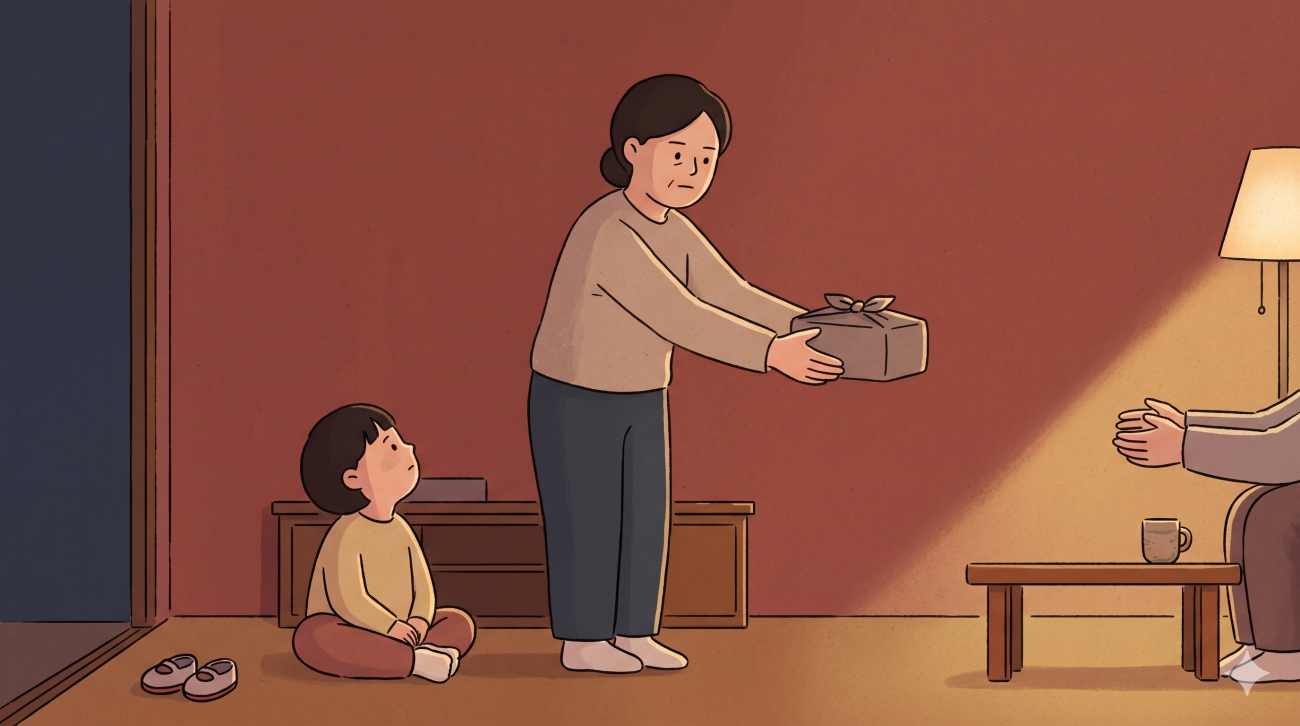
My niece had just learned to walk. When we passed a neighbor in the hallway, I prompted her to bow. When older kids from the building were nearby, I nudged her toward them — go on, ask if they want to play. And whenever she handed something to an adult, I told her: use both hands. She could barely stay upright, and already she was learning this. In Korea, korean etiquette around giving and receiving isn’t taught in a classroom. It starts before a child can read.
You Learn It Before You Can Spell It
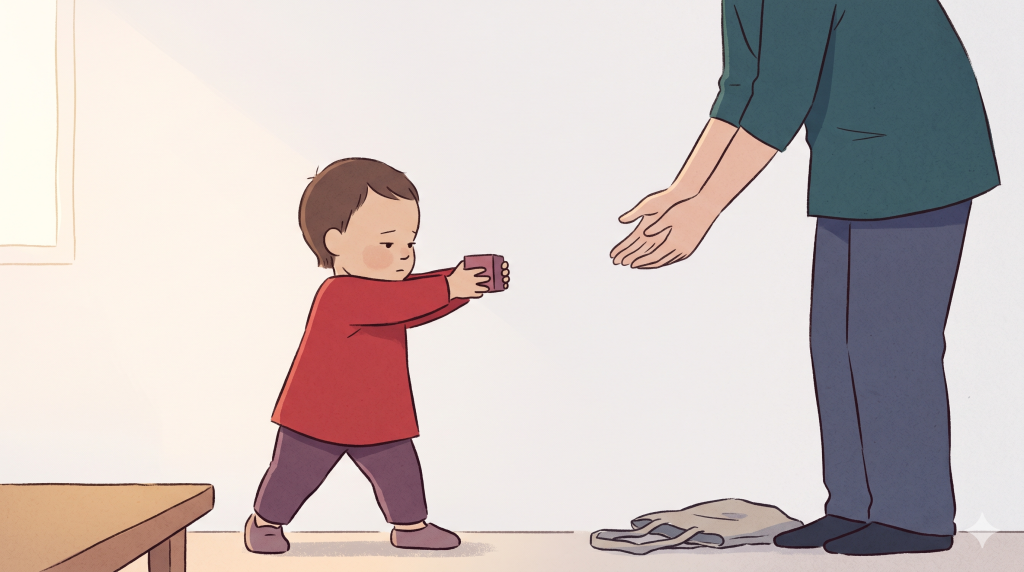
Korean manners around two-handed giving aren’t introduced through lessons or explanations. They arrive in small repeated moments — a parent’s nudge, a whispered instruction before handing something to a grandparent, the same phrase said again and again until it stops needing to be said at all. The three things Korean children tend to learn earliest in social settings are: greet elders when you see them, approach older kids first rather than waiting, and use both hands when you give something. Nobody stands in front of a chart and explains the rules. They’re absorbed through repetition, in real time, in actual situations.
My nieces and nephews went through exactly this. Before they could understand why, they were already doing it. And then at some point, the instruction stopped being necessary. The hands moved on their own. That’s what happens when something is taught early and often enough — it stops being a rule and becomes part of how the body moves through the world. People who grew up with this kind of etiquette will reach out with two hands in situations where one would be perfectly fine, simply because the habit runs that deep.
Korean Etiquette in Everyday Life — One Hand or Two?
At a convenience store checkout, passing a card to the cashier with one hand is completely fine. Handing a receipt back to a restaurant server, submitting forms at a hospital reception desk — these are ordinary transactional moments, and one hand doesn’t carry any particular meaning in these contexts. It isn’t read as dismissive or disrespectful. One hand is simply one hand.
That said, people who grew up absorbing this Korean giving and receiving etiquette early may find both hands coming up automatically even in situations where it isn’t strictly required. It isn’t a deliberate choice — it’s what the body has been trained to do. The card gets held out with two hands and the person doing it may not even notice. The gesture is running on habit, below the level of conscious thought.
What actually matters is the context. A casual transaction and a situation involving age or hierarchy read very differently. Handing a card to a cashier with one hand and handing a document to a senior colleague with one hand are the same physical action, but they don’t carry the same weight. Knowing the difference — sensing when the situation calls for more care — is closer to how Korean hand gestures actually function in practice.
When Two Hands Actually Matter
When handing documents to a direct superior at work, or presenting a gift to an elder — these are situations where two hands are the natural choice. There’s no need to deliberate. If a supervisor happens to be younger than you, there may be a slight moment of calculation. But with someone clearly older, the two-handed gesture comes without much thought.
That said, if someone uses one hand in these moments, it doesn’t cause an obvious disruption. The room doesn’t go quiet. What tends to happen is quieter: an internal note is made — something like, this person didn’t learn that — and the moment passes. Korean etiquette often works this way. The response to a social misstep is rarely visible. It happens inward, and then it’s over.
There is a related gesture worth knowing. Rather than using both hands fully, a person might extend one hand while the other supports the wrist or forearm of the giving arm. The meaning is similar to the full two-handed gesture. Some explanations trace this back to the long, wide sleeves of traditional Korean dress, where holding the sleeve back with the opposite hand was a practical necessity that became a marker of care over time. Whether or not that origin story is precise, the gesture itself is still used today — the sleeves are long gone, but the hand position remains.
Business Cards, First Meetings, and the Stranger Rule
Among close friends or people of similar age, two hands don’t tend to appear. Pulling out both hands in a casual, familiar exchange would feel oddly stiff — like adding formality where none is needed. Korean two hands etiquette is, at its core, a way of acknowledging distance: it signals that you’re aware of where you stand in relation to the other person, and that you’re choosing to be careful with that gap.
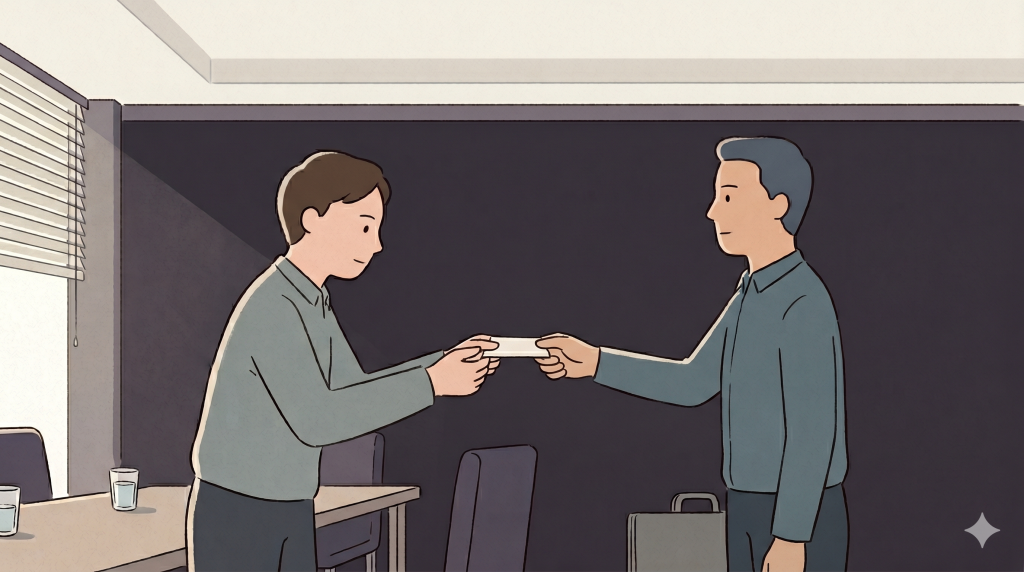
But age similarity alone doesn’t automatically mean one hand is fine. When meeting someone for the first time, even a peer, exchanging business cards with both hands is natural. In that initial moment, before any familiarity has formed, the two-handed gesture communicates something specific: I’m taking this meeting seriously. As the relationship develops and the distance closes, the formality softens. One hand settles in where two hands once were. The shift tracks the relationship. Two hands at the beginning; one hand once things are understood between you.
What Foreigners Get Wrong — and Why It Doesn’t Matter
When a foreigner in Korea hands something over with one hand, many Koreans don’t make much of it. The understanding is simply that customs differ. If someone were to insist that visitors must follow Korean etiquette to the letter — that being in Korea obligates full compliance — that would say more about that particular person’s temperament than about any general expectation in Korean culture.
The gap between K-Drama and daily life is worth addressing directly. Dramas show two-handed exchanges naturally — a junior employee presenting documents to a supervisor, someone receiving a glass from an elder. These scenes aren’t theatrical exaggerations. They reflect what actually happens in those specific situations. But a drama doesn’t spend much time in convenience stores or casual cafés, where one hand is perfectly unremarkable. What dramas show is the register that applies in formal or hierarchical moments. What they leave out is the much larger portion of everyday life where none of this applies at all. Both are real. They just belong to different kinds of scenes.
A Gesture That Carries Weight
I still think about that moment with my niece — telling a child who could barely walk to use both hands. She had no idea what it meant. She did it because someone told her to. But with enough repetition, the instruction becomes unnecessary. The hands move first, and the understanding comes later, or maybe never needs to come at all — because the body already knows.
In the end, two-handed giving in Korea is a way of expressing respect and consideration through a physical gesture. It reads the distance between people and adjusts accordingly. The question of one hand versus two is almost beside the point. What the gesture carries is an awareness of the other person — a small, quiet signal that you noticed them, that you’re not just moving through the space they happen to occupy. For a foreigner trying to understand what they’re seeing, that might be the most useful frame: when a Korean reaches out with both hands, what’s being passed along isn’t only the object.
Why do Koreans use two hands when giving or receiving things?
Using two hands is a way of showing respect and acknowledging the other person’s position. It signals care and attentiveness — particularly in situations involving age, hierarchy, or a first meeting. It’s less a rigid rule than a social habit that communicates how seriously you’re taking the exchange.
Is it rude to use one hand in Korea?
It depends on the situation. In casual, transactional settings like convenience stores or cafés, one hand is completely normal and carries no negative meaning. In more formal contexts — handing something to an elder or a senior at work — one hand may register as a lapse in manners, though the response is usually internal rather than openly expressed.
Do foreigners need to follow Korean two hands etiquette?
Most Koreans don’t expect foreign visitors to already know or follow this custom. Using one hand is unlikely to cause offense. That said, making the effort — even imperfectly — tends to be noticed and appreciated, particularly in more formal or interpersonal situations.
What does the wrist-supporting gesture mean in Korean etiquette?
Supporting the wrist or forearm of the giving arm with the opposite hand carries a similar meaning to using two hands fully. It’s a softened version of the same gesture — an indication of care and respect, offered in situations where the full two-handed form might feel excessive but some acknowledgment still feels appropriate.
When is it okay to use one hand in Korea?
One hand is fine in most casual, everyday interactions — paying at a store, passing items between friends, routine exchanges in public spaces. Two hands become more relevant when there’s a meaningful age gap, a formal setting, a first meeting, or a situation involving hierarchy. The context, more than the action itself, determines which feels appropriate.
