Korean Drinking Etiquette: Why Koreans Pour Soju With Two Hands
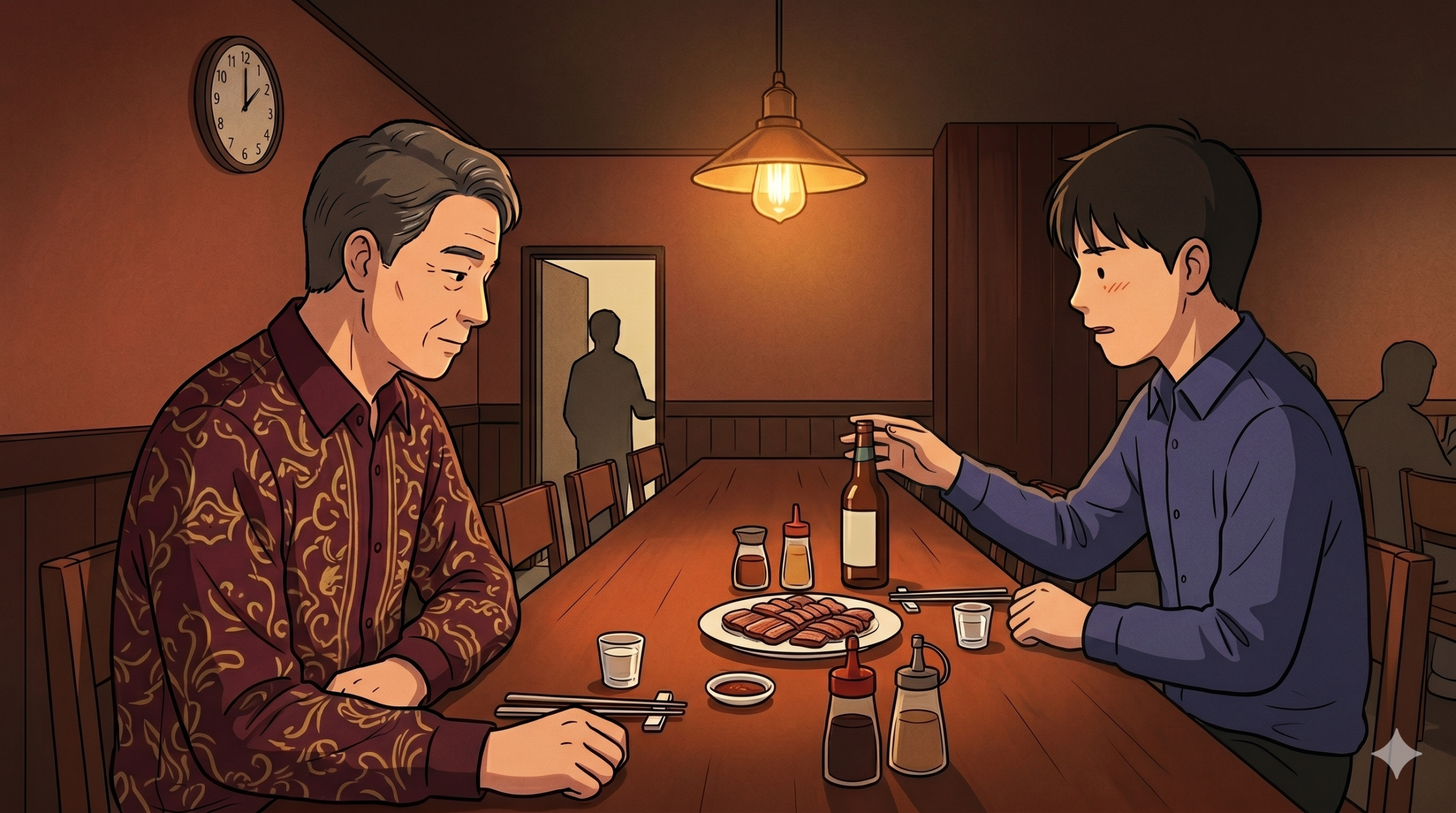
If you’ve ever watched a Korean drama and paused at a drinking scene — not because of what was being said, but because of what was being done — you’ve already noticed it. Someone’s glass runs empty. The person beside them reaches for the bottle. Two hands. The one pouring uses two hands; the one receiving uses two hands. And when there’s an elder at the table, the person drinking turns their head to the side, raising the glass just slightly out of the elder’s direct line of sight. To an outside eye, it can look like a lot of ceremony for what is, after all, just a drink. But korean drinking etiquette isn’t really about the drink. It never was.
The Summer My Father Taught Me How to Drink

I first learned judo (주도, Korean drinking manners — not the martial art) during summer vacation, the year I was in the second year of high school. I was reading a borrowed comic book when my father called me over. He had been drinking alone at the low table in the living room — what Koreans call banju (반주), the practice of having a drink alongside a meal. He poured a glass of beer and set it in front of me. “Try some,” he said. “It’s fine when an elder offers. You’re about to graduate and go out drinking anyway — better to learn judo from your father first.”
That was the first formal lesson. But he had been teaching me informally since I was much younger. At family gatherings, at dinner tables where older relatives were present, he would show me — not by sitting me down and explaining, but by having me watch, and then by letting me try. How to hold the bottle when pouring for an elder. How to position both hands when receiving a glass. Where to look when you drink. In Korea, drinking manners are not in any textbook. They are passed from one person to the next, across a table, with a glass between you.
Banju was a quiet, ordinary part of my father’s evenings. A small glass of soju alongside dinner, taken slowly while the rest of the family ate. That living room table, lit in the early evening, was where I first understood that drinking and manners in Korea are not two separate things. They arrive together.
Korean Drinking Etiquette Is About Distance, Not Just Rules
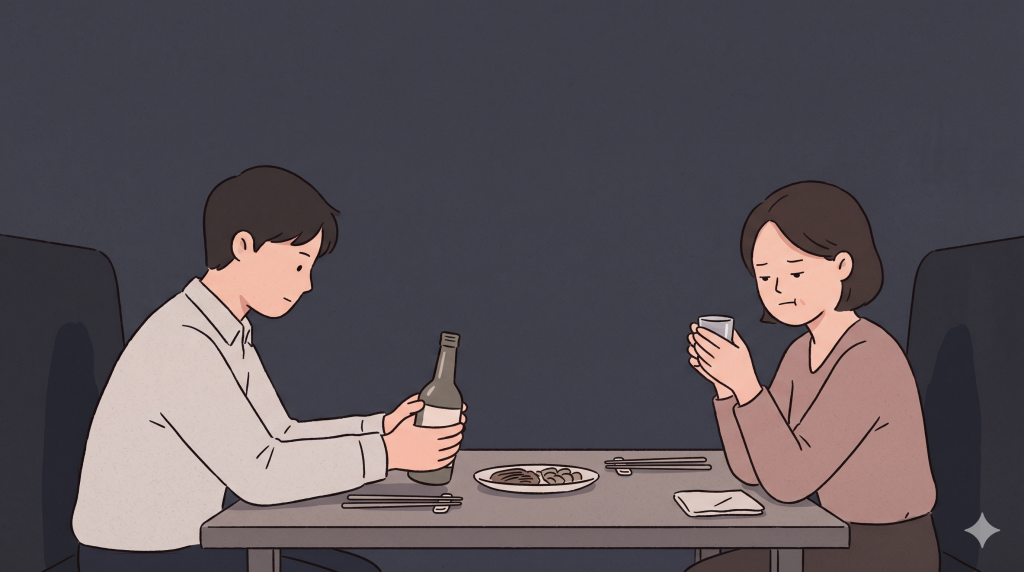
Using two hands to pour and receive is not a purely ceremonial gesture. It carries information. It tells the other person where they stand in relation to you.
When receiving a drink from someone significantly older — a direct superior at work, or an elder with a clear age gap — the proper form is to receive with both hands and, when drinking, to turn the head to the side and partially shield the glass. Drinking while facing an elder directly, letting them see the full act of swallowing, carries a feeling of disrespect that is difficult to articulate but immediately legible to anyone who grew up with it. When the age gap is smaller — a year or two, someone you know but aren’t fully comfortable with — the form shifts slightly. Both hands still come up to receive, but when drinking, only the body turns, without the shielding gesture. It is the same basic courtesy with one layer of formality removed.
Korean drinking etiquette adjusts this way across every combination of relationship, age difference, and context. There is no fixed chart to memorize. What guides it is the ability to read the room — to sense what the occasion requires and calibrate accordingly. Among close friends of similar age, these forms dissolve almost entirely. One hand is fine. Turning away isn’t expected. The intensity of the etiquette tracks the formality of the relationship, not a universal standard.
Why Pouring Your Own Drink Can Feel Lonely in Korea
There is a feeling attached to pouring your own drink in Korean drinking culture that is hard to translate directly. The closest word might be lonely. Or, in a slightly different register: neglected.
The logic underneath it goes something like this. If you have come out to drink with someone — to talk, to listen to each other’s troubles, to mark something worth marking — then the person across from you is responsible for your glass. That is part of what it means to be in that seat. Pouring your own drink signals, however unintentionally, that no one is watching your glass. That no one is paying attention. In a culture where drinking together is understood as a form of care, filling your own glass can read as a quiet statement that the care isn’t there.
There is even an old joke about it: if you pour your own drink while someone is sitting across from you, bad luck follows that person for three years. No one takes it literally. But the joke has survived because the underlying feeling is real. An empty glass is a signal. Refilling it is a response. The back-and-forth of pouring — who notices, who reaches, who receives — is one of the ways a Korean drinking table communicates that people are present for each other.
Hoesik vs Friends — The Same Drink, Two Different Worlds
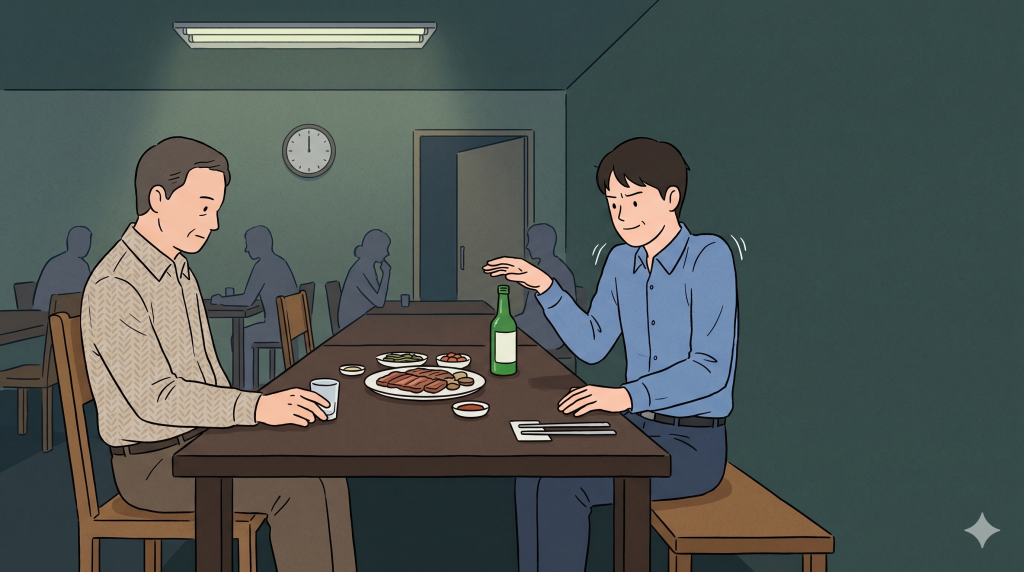
Hoesik (회식) and a casual night out with friends may both involve the same bottle of soju, but they are not remotely the same experience.
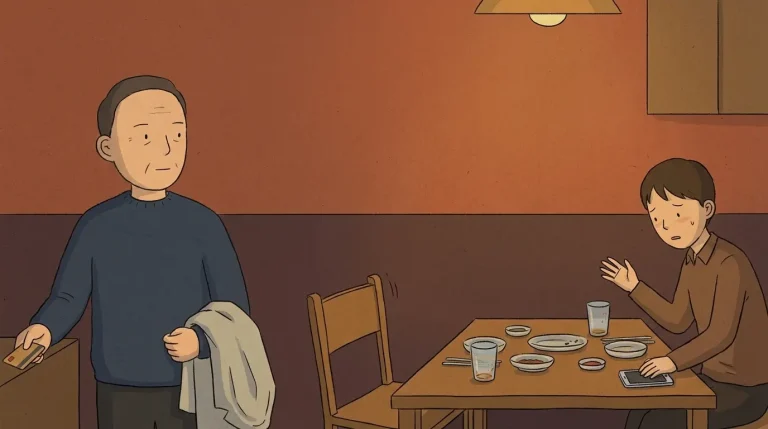
A hoesik is a gathering of people from different positions within a company. A team leader, a deputy, a junior employee who joined last month. The hierarchy that structures the workday follows everyone to the restaurant. Depending on the department — whether it skews heavily male or female, whether the culture is formal or loose — there may be more or less rigidity, but some level of it is almost always present. Pouring hands are a little more careful. Posture doesn’t fully relax. There is a low-level awareness of whose glass is empty and whether you noticed in time. Some younger office workers today find this exhausting enough that they’d rather skip hoesik entirely and go home. Compared to how company dinners felt when I was in my twenties, something has clearly shifted. Whether it’s that the formality has loosened, or simply that fewer people are showing up, is probably both.
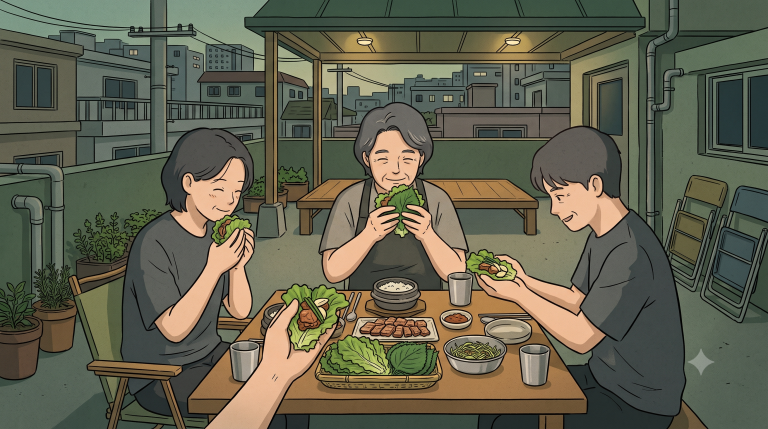
Drinking with friends operates by entirely different rules. The topics are unlimited. The formality is gone. Pouring your own drink is fine, going glass-to-glass with someone the same age requires no ceremony, and nothing about the table needs to be managed. The point of being there is simply to be there together.
What a Foreigner Should Actually Know
If a foreigner sits down at a Korean table and doesn’t know any of this — doesn’t use two hands, doesn’t turn away when drinking, pours their own glass — most Koreans won’t be offended. The expectation that a visitor would arrive already knowing these things simply isn’t there. If someone has taken the time to learn before coming, that’s touching. If they haven’t, that’s just normal. What would genuinely bother people at a Korean table has nothing to do with etiquette: it would be causing harm to the people around them, or destroying the mood of the gathering entirely.
There is, though, one thing worth understanding before sitting down. In the Korean language, people don’t say “my country” — the phrase that comes naturally is uri nara (우리나라), which means “our country.” That habit of framing things as shared rather than individual shows up in how Koreans understand a drinking table too. When geonbae (건배) is called out — the Korean equivalent of a toast — it isn’t just a signal to drink. At a company dinner, it means something like: let’s keep pushing forward together tomorrow. Among friends, it means: may what we’re each working toward go well, and may this last. In the moment the glasses come together, everyone at the table briefly becomes uri — “us.”
Somaek (소맥) is part of the same spirit. Soju on its own can be too sharp; someone started cutting it with beer. Over time, that casual workaround became its own practice, with people developing strong opinions about the ideal ratio. The search for the version that tastes best together — that’s also the uri logic. Making the shared experience a little better than it would have been alone.
The Glass My Father Poured
I still see it clearly: the low table in the living room, the summer evening light, my father setting a glass of beer in front of me. What I learned that day wasn’t how to drink. It was what a Korean drinking table is actually for. Two hands on the glass when receiving, head turned when drinking in front of an elder — each of those gestures is a way of saying something without words. That you are aware of the other person. That you are not just sitting across from them, but with them.
If you watch a Korean drama scene where someone pours with two hands, that image might look a little different now. It is not simply a rule being followed. It is one of the ways people at that table read the distance between themselves, adjust it, and communicate across it. And the person who first showed me what that meant wasn’t a teacher or a textbook. It was my father, one summer evening, pouring a glass he didn’t have to pour.
What is korean drinking etiquette?
Korean drinking etiquette refers to the set of unspoken social practices that govern how people drink together in Korea — including using two hands to pour and receive drinks, turning away when drinking in the presence of elders, and not pouring your own glass. These aren’t rigid rules so much as ways of reading and communicating the relationship between people at the table.
Why do Koreans use two hands when pouring soju?
Using two hands signals respect and awareness of the other person. The formality of the gesture scales with the relationship: with a significantly older person or senior colleague, both hands and a turned head when drinking are expected. With someone closer in age or in a more relaxed setting, the form softens — but the basic awareness behind it remains.
Is it rude to pour your own drink in Korea?
It’s less about being rude and more about what it communicates. Pouring your own drink in the presence of others can feel lonely or signal that no one is paying attention to your glass. In Korean drinking culture, refilling someone’s glass is a form of care — so letting your own glass stay empty, or filling it yourself, can carry a quiet message that wasn’t intended.
What is the difference between hoesik and casual Korean drinking?
Hoesik is a company gathering where workplace hierarchy follows everyone to the table. It tends to be more formal, with more attention to whose glass is empty and what the senior person is saying. Drinking with friends operates without those structures — the conversation is open, the formality is gone, and the only goal is to enjoy being together.
Do foreigners need to follow Korean drinking etiquette?
Most Koreans don’t expect foreign visitors to already know these customs, and not knowing them won’t cause offense. If you’ve taken the time to learn before sitting down, that will likely be appreciated — but it isn’t required. The one thing that matters most at a Korean table is the same as anywhere: being genuinely present for the people you’re with.