
Why Koreans Say “Uri” and Not “My” — A Korean’s Honest Attempt to Explain
Someone posted on Reddit not long ago about a conversation with their Korean friend. The friend had been talking about his wife — casually, in the middle of a story — and used the phrase “our wife.” The Reddit poster stopped reading, went back, re-read the sentence, and then typed: “Wait. Our wife?” The comment section was part laughter, part genuine confusion. Someone explained that this was a Korean thing. Someone else asked: “Does that mean they say ‘our mom’ too?” And then the thread really got going.
I read through that thread and felt something I hadn’t expected: a small jolt of recognition. Not because I thought the Korean usage was wrong. I’ve been saying uri (우리) my entire life — uri eomma (우리 엄마) for my mom, uri jip (우리 집) for my house, uri hoesa (우리 회사) for my company. It never occurred to me that any of it was strange until someone from outside asked. That’s the thing about language absorbed from childhood: it doesn’t announce itself. It’s already inside you before you have the chance to examine it.
This becomes especially visible in K-Drama subtitles. When a character says uri eomma, the subtitle often reads “our mom” — a direct translation that is technically correct and socially baffling to anyone watching for the first time. The mom being referred to belongs to exactly one person in that scene. But “our mom” in English suggests something else entirely: a shared parent, a household arrangement that requires explanation. Viewers write about this in comment sections and forums, not because the translation is wrong, but because the word-for-word version doesn’t carry the right meaning across. The confusion isn’t a translation error. It’s a gap between how the two languages understand belonging.
This is my honest attempt to explain uri meaning — not as a linguist, but as someone who had to be asked about it before I could see it clearly.
When One Person’s House Becomes “Ours”
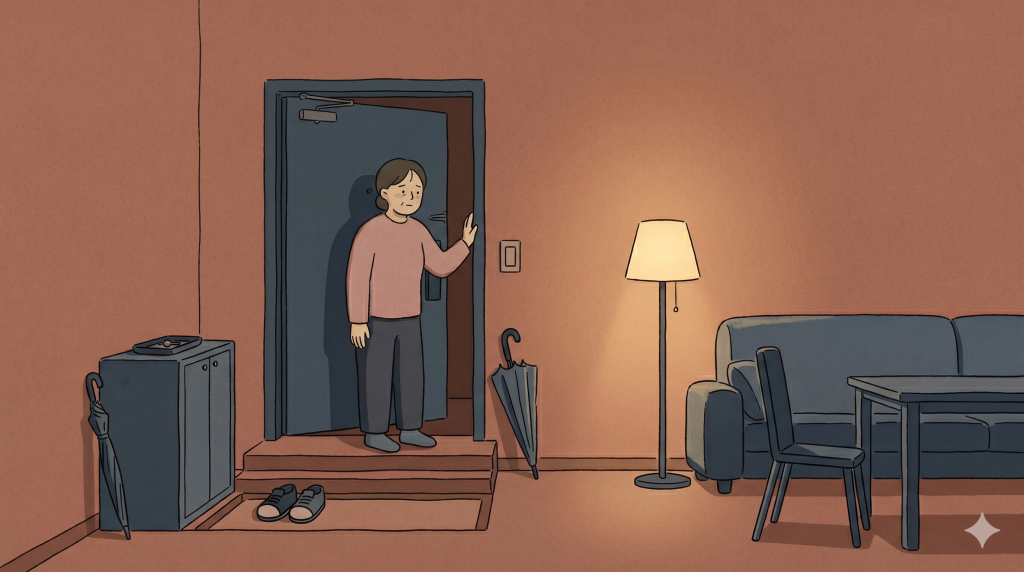
I live alone. I signed the lease alone, and every month the rent comes out of my account and no one else’s. And yet, if a friend asks about my place, what comes out naturally is uri jip (우리 집) — our house. Not “my house.” Ours.
Nae jip (내 집) — “my house” — would be grammatically fine. The meaning is exactly the same. But it sits differently. It sounds like something out of a legal document, or a formal complaint. When someone says nae jip in casual conversation, there’s a slight stiffness to it, as if they’re stressing the ownership of something. As if they’re drawing a line. Uri jip just flows. It doesn’t call attention to itself.
This isn’t limited to homes. In Korean, uri hakgyo is how students refer to their school, uri gajok is how people refer to their family, and uri nara is how Koreans refer to their country. The first verse of Korea’s national anthem, the Aegukga, contains the phrase uri nara manse (우리나라 만세) — roughly, “long live our country.” Korean children grow up hearing the country called “ours” before they’ve learned to question what that means. By the time they’re old enough to ask why, they’ve been saying it for years.
The best explanation I can offer is this: in English, “our” signals shared ownership — multiple people, one thing. In Korean, uri signals belonging. It means this person, this place, this institution is part of the world I live inside. The single syllable carries not a headcount but a relationship.
The Boss Who Still Says “Our Company”

I know someone who has run his own company for over a decade. He started it alone, built the client list himself, and still handles the accounts personally. When he meets people for coffee and talks about work, he says uri hoesa (우리 회사) — “our company” — and mentions that a capable new employee just joined. Not “my company.” Ours. Even though the company bears his name on the front door.
Nae hoesa (내 회사) — “my company” — does get used, but in different contexts. A formal contract. A negotiation where ownership matters. A moment where someone needs to make clear that they, specifically, are the one responsible. In everyday conversation, even the founder defaults to uri. Saying “my company” in casual speech sounds oddly grandiose — like a line from a drama where the chaebol heir is announcing himself.
Both the employee and the employer say uri hoesa. The word doesn’t encode hierarchy or ownership percentage. It encodes presence. You’re there, you’re part of it, it’s yours in the sense that matters most in daily life — even if the legal documents say otherwise. The gap between what the word implies in Korean and what it would imply in English is not an approximation or a mistranslation. It’s simply how these two languages have decided to handle the relationship between a person and the things they belong to.
Why “Our Husband” or “Our Wife” Does Not Mean What It Sounds Like
This is where the confusion gets most entertaining — and hardest to resolve quickly. A Korean man might say uri waipeu (우리 와이프, literally “our wife”) worked late last night, and mean, without any ambiguity, that he is talking about his own wife. He is not proposing an arrangement. He is not making an unusual statement about his marriage. He is simply telling you what happened the night before.
Uri waipeu and uri nampyeon (우리 남편, “our husband”) are the natural, everyday ways Koreans refer to a spouse in conversation. Despite the literal translation sounding like shared ownership, the meaning is simply “my spouse.” The same logic applies as with uri eomma — the word signals closeness and belonging, not an unconventional household.
Occasionally someone will say nae waipeu or nae nampyeon — using nae (내) instead of uri. It happens. But the tone shifts slightly when it does. Nae in this context tends to appear when there’s emphasis involved: a firm correction, a strong feeling, a moment where the speaker needs to stress something that uri doesn’t quite carry. “That’s not something my husband would do.” In that sentence, “my” is doing work that uri simply cannot. For everything else, uri is the word that comes naturally, without deliberation.
Where “Uri” Stops and “Nae” Begins
Here is the part I find genuinely difficult to explain — including to myself. I don’t say uri for my phone, my bag, or my shoes. Those are nae — mine. If I referred to my own phone as uri phone, the person next to me would look around wondering who else was involved. The uri stops somewhere, and nae takes over, but the line between them isn’t written down anywhere I know of.
A convenient answer would be to say that uri reflects Korea’s collectivist culture — the group over the individual, the shared over the personal. But that framing is too large and too flat to be useful. Plenty of things in daily Korean life are firmly nae: my phone, my bag, my room, my money. If collectivism were the whole explanation, those things would be uri too. Reducing this word to a cultural label skips over the more specific, more interesting reality: uri doesn’t appear everywhere, and where it does appear tells you something particular about the Korean sense of connection — not a national character trait, but a quiet map of where a person feels they belong.
What I can say is that uri appears for things I belong to, not just things that belong to me. A family is something I came from. A house is somewhere I return to. A company is somewhere I spend my days. A country shaped the language I’m using right now. These things hold me as much as I hold them. My phone, on the other hand, is just mine. I carry it. It doesn’t carry me.
This isn’t a distinction learned from a textbook. Korean speakers absorb it through years of listening and speaking — the same way a person learns which words feel right in which situations before they’ve ever tried to explain why. The line between uri and nae is real; it’s just not the kind of line you find on a grammar chart.
The person who posted on Reddit eventually got their answer, sort of. Someone wrote: “Because in Korean, ‘my’ sounds weird there.” That reply is not wrong. Nae eomma sounds stiff. Nae jip sounds like a contract. Nae nampyeon sounds like emphasis. None of those are the register most Koreans are reaching for when they talk about the people and places at the center of their lives. I didn’t know any of this consciously until I had to explain it. I’ve been saying uri eomma my entire life, and it took a Reddit thread — and a lot of thinking afterward — to make me notice something I’d never once questioned.
The next time a K-Drama subtitle reads “our mom” and you do a double take, now you know: the character means her mom. She’s not sharing. She’s using the word that sounds right to her, in a language where belonging and ownership don’t always point in the same direction.
What does uri mean in Korean?
Uri (우리) translates literally to “our” or “we,” but understanding the real uri meaning requires a small shift in thinking. In Korean, uri is used where English speakers would say “my” — for a mom, a house, a company, even a spouse. The word doesn’t signal shared ownership. It signals belonging: whatever a Korean speaker feels connected to tends to become uri, regardless of how many people are actually part of the picture.
Why do Koreans say uri eomma instead of nae eomma?
Nae eomma is grammatically correct but sounds stiff or overly formal in everyday speech. Uri eomma is the version most Koreans grow up hearing, and it comes out without deliberation. Choosing nae in casual conversation can carry unintended weight — as if the speaker is stressing ownership rather than simply referring to a parent.
Is uri the same as “our” in English?
Not exactly. In English, “our” implies multiple people sharing something. In Korean, uri can refer to something that belongs to a single person. A Korean living alone will still call their apartment uri jip. The key difference is that English “our” counts people, while Korean uri describes a relationship — the speaker belongs to this thing, or this thing is part of the speaker’s world.
Can uri be used for a husband or wife?
Yes. Uri waipeu (우리 와이프) and uri nampyeon (우리 남편) are the natural, everyday ways Koreans refer to a spouse in conversation. Despite the literal translation sounding like shared ownership, the meaning is simply “my spouse.” The same logic applies as with uri eomma — closeness and belonging, not an unusual arrangement.
When do Koreans use nae instead of uri?
Nae (내) appears for personal objects — a phone, a bag, a wallet — and for moments that carry emphasis. In everyday references to family, home, workplace, and country, uri is the default. The distinction isn’t a formal grammar rule; it’s a sense that Korean speakers develop through years of exposure. Like many things in language, it’s absorbed through feel long before anyone tries to explain it.
