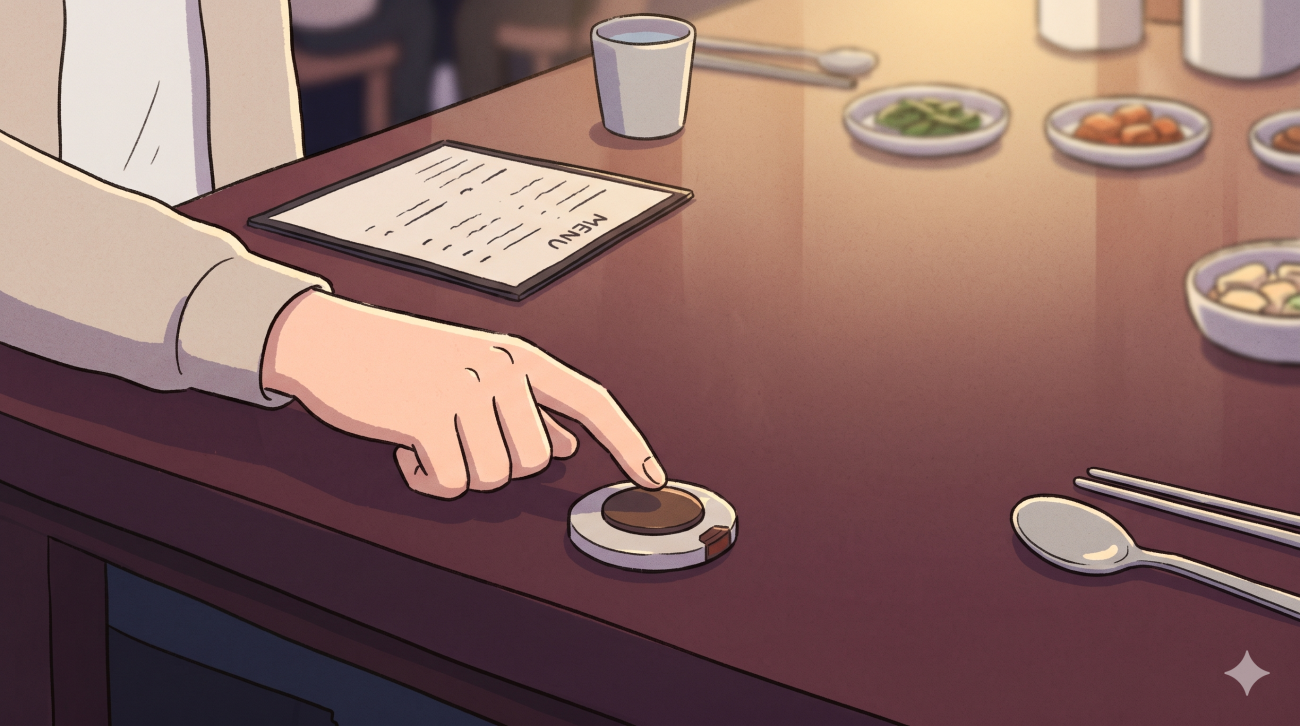
Have you ever sat down at a Korean restaurant and noticed a small button sitting next to the menu? It might be attached to the edge of the table or resting beside the condiments — a Korean restaurant call button, just sitting there. If you found yourself wondering whether you’re allowed to press it, or whether pressing it might come across as rude or demanding, that hesitation is completely understandable. The answer is simple. You can press it. In fact, that’s exactly what it’s there for.
Korean Restaurant Call Button — The Moment Everyone Hesitates
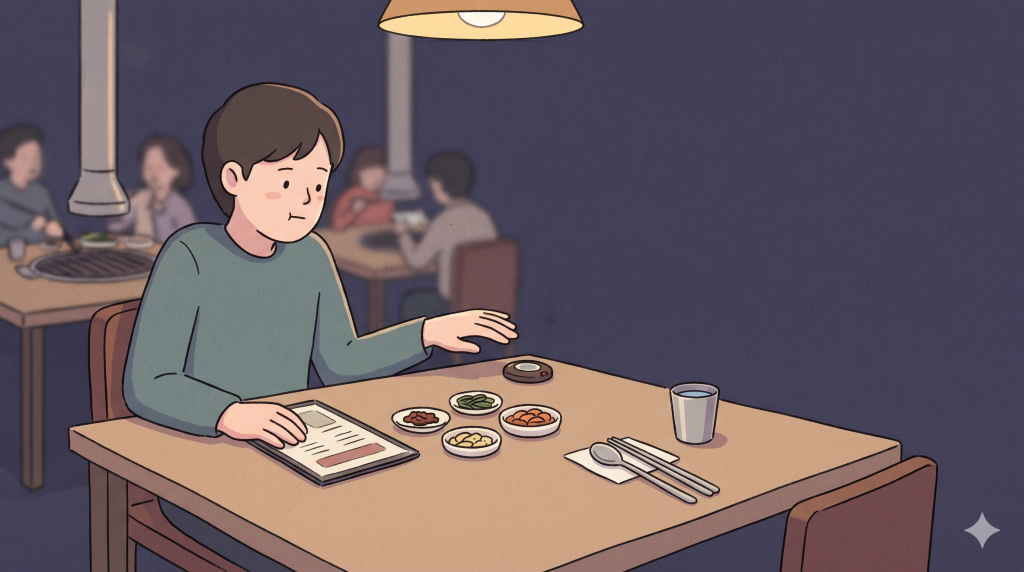
I’ve watched more than a few TV segments where foreigners visit a Korean restaurant for the first time. Among everything that catches their attention — the grill in the middle of the table, the row of small side dishes arriving before any order is placed — the call button tends to stop people cold. It looks like a doorbell sitting on a dining table, which is not something most people have seen before. Most of them spent a moment debating whether they were actually supposed to press it. One person tried it hesitantly, and when a staff member came over with a calm “ne~” (yes, coming), they looked genuinely surprised. They hadn’t expected a response to arrive that quickly.
That reaction makes sense. In many countries, summoning a server with a dedicated button at the table isn’t part of the standard dining experience. But in a Korean restaurant, pressing this button is not a demanding gesture. It’s a practical service tool — designed so that customers can ask for help exactly when they need it, without having to wait for a staff member to pass by at the right moment.
How the Korean Restaurant Call Button Works
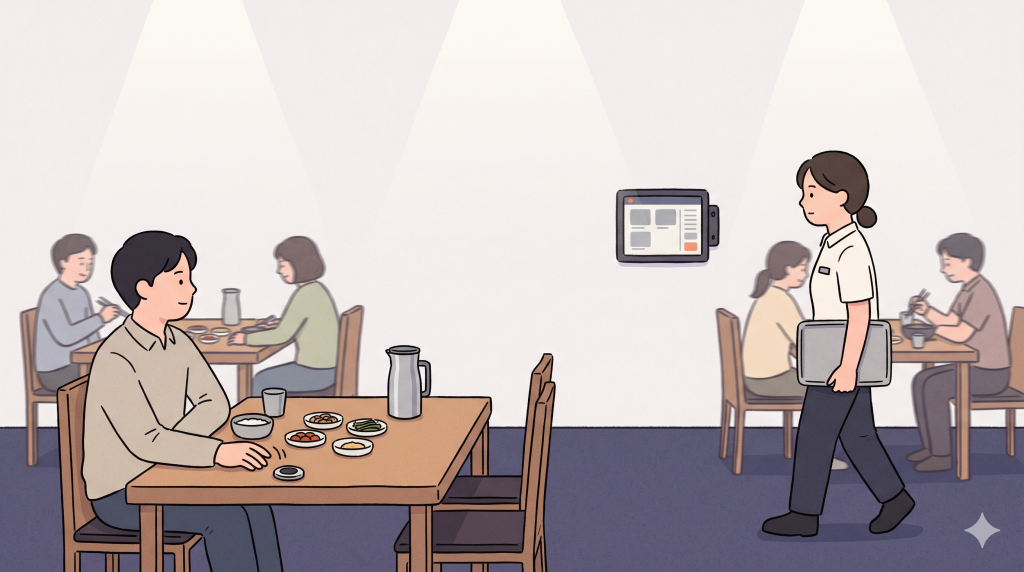
Before the call button became common, there was a different system. To get a server’s attention, people called out 이모 (imo) — a familiar way to address a middle-aged woman working in a restaurant, somewhere between “ma’am” and “auntie.” You raised your voice, and someone came over.
The problem appeared during busy hours. Staff weren’t always sure which table to go to first, and in the middle of a rush, a request could easily slip through. The Korean restaurant call button system solved that problem structurally. When a customer presses the button, a screen on the restaurant wall displays the table number. Staff can glance at the screen and immediately see which table needs attention, and in what order. Nothing gets lost in the noise of a busy room. That’s what makes korean table service run more smoothly during peak hours — the information is already up on the wall before anyone has to move.
On quieter evenings, people don’t always reach for the button at all. Calling out 저기요 (jeogi-yo — excuse me) works just as well when a staff member is nearby. The button is one option, not the only one.
Jeogi-yo and Imo — When There’s No Button
Not every Korean restaurant has a call button. Older neighborhood spots and smaller casual places tend to rely on voice instead. In those cases, 저기요 (jeogi-yo) is the most reliable phrase to know. It works in any restaurant setting — casual or more formal — and staff respond to it naturally. 여기요 (yeogi-yo) means the same thing and is used interchangeably. For anyone visiting Korea and figuring out how to order in Korea for the first time, 저기요 is the one expression worth memorizing before anything else.
이모 (imo) carries a different tone. It’s the kind of thing you hear at a long-running neighborhood sikdang (식당, restaurant) or a bunsikjip (분식집, casual snack restaurant) — places where the atmosphere is relaxed and the rapport between customers and staff feels more familiar. For foreign visitors, 저기요 is the safest and most universally appropriate choice. It fits any situation, and no one will find it out of place.
In casual settings, customers sometimes skip the calling step and go straight to making a request out loud. That can work in a relaxed environment — but keeping the volume moderate is a good idea. A calm voice at a reasonable distance gets the point across without drawing attention from the rest of the room. It’s a small but useful korea travel tip when navigating korean dining etiquette for the first time.
Why Korean Servers May Not Check on You Often — And Why That’s Not Rudeness
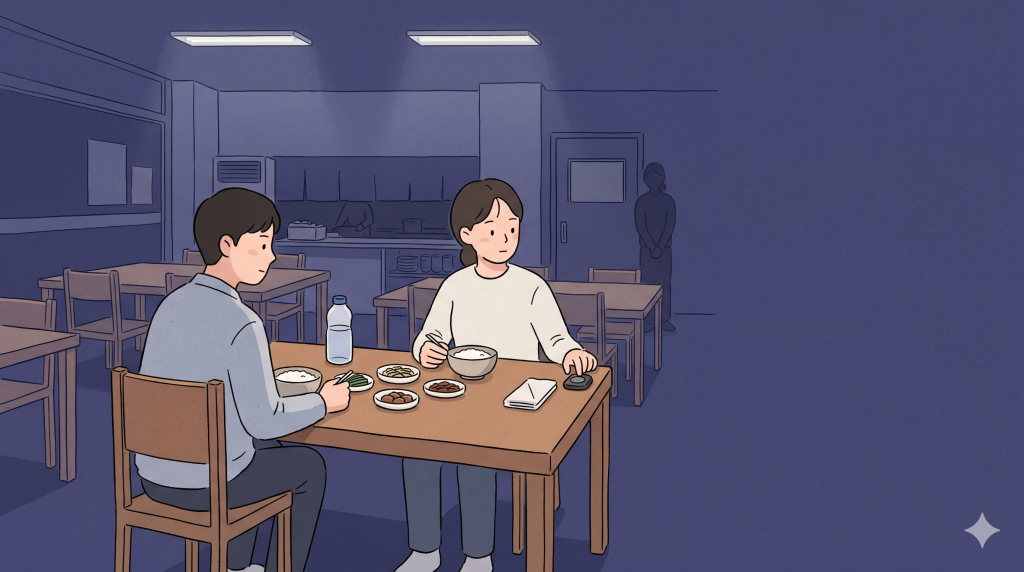
One thing that sometimes reads as cold to first-time visitors is this: Korean restaurant staff don’t typically stop by tables to check in. There’s no mid-meal “Is everything okay?”, no routine water refill, no check-in between dishes. If you’re used to a different style of service, the silence can feel like being overlooked.
From a Korean perspective, it lands differently. Being interrupted repeatedly during a meal — “Are you doing alright?”, “Do you need anything?” — is uncomfortable. It breaks the rhythm of eating and draws attention to the table at moments when nothing is actually needed. The ideal meal in this framework looks something like this: food arrives, you eat without interruption, you press the button when something comes up, the staff member approaches, you say what you need. That’s the exchange. Calm, efficient, and on your own terms.
This is korean service culture working as intended — not indifference, but a form of consideration for the customer’s space. The service isn’t absent; it’s waiting to be activated. The call button is what activates it.
What to Use It For — and One Simple Tip
The button covers most situations that come up during a meal at a Korean restaurant. Asking for a banchan refill (반찬, the small side dishes that arrive at the start of the meal and can be replenished for free) is one of the most common uses. Requesting more water, placing an additional order, asking for utensils or napkins — all standard. If you’re at a korean bbq restaurant and need the staff to help with the grill, the same button handles that too.
One thing worth knowing about payment: not every Korean restaurant settles the bill at the table. Many places, especially casual ones, have customers pay at the counter on the way out. Pressing the button to ask about the check is perfectly fine, but walking toward the counter at the end of the meal often communicates the same thing — staff will usually understand right away.
One simple rule covers everything else: press once and wait. The moment you press the button, the table number has already appeared on the wall screen. Staff have seen it. If they don’t arrive immediately, it’s because they’re finishing up at another table — not because the signal was missed. Pressing again doesn’t speed things up and can create confusion in a busy room. One press is all it takes. Then you wait.
That’s really the whole system. No complicated technique, no social risk. The button is there to make things easier, and it does exactly that.
The foreigners in those TV segments — the ones sitting at the table, debating whether to press it — all eventually did. And the moment a staff member responded with a simple “ne~”, something shifted. The confusion turned into something closer to relief. It turns out pressing a button and getting a calm, unhurried response is one of the more straightforward things about eating at a Korean restaurant. You just have to press it once to find out.
What is the call button at Korean restaurants for?
The call button is a service tool built into the table that lets customers summon a staff member whenever they need something. Pressing it sends a signal to a screen on the restaurant wall, displaying the table number so staff know exactly where to go. It’s used for banchan refills, water, additional orders, and anything else that comes up during the meal.
Is it rude to press the call button at a Korean restaurant?
Not at all. In Korea, pressing the call button is the normal and expected way to get a server’s attention. It isn’t considered demanding or impolite — it’s simply how the service system works. Pressing it once and waiting calmly is all that’s needed.
What do I say if there’s no call button at a Korean restaurant?
저기요 (jeogi-yo) is the most reliable phrase. It means something close to “excuse me” and works in any restaurant setting. 여기요 (yeogi-yo) means the same thing and can be used interchangeably. Either one will get a staff member’s attention without any awkwardness.
Why don’t Korean restaurant servers check on the table very often?
In Korean dining culture, frequent check-ins during a meal can feel like an interruption rather than attentive service. The call button system is designed so that customers ask for help when they actually need it, rather than being approached at regular intervals. It’s a different service model — not indifference, but consideration for the customer’s space.
How do I pay at a Korean restaurant — at the table or at the counter?
It depends on the restaurant. Some places accept payment at the table after pressing the call button to request the bill. Many casual Korean restaurants, however, have customers pay at the counter on the way out. When the meal is finished, walking toward the counter usually signals to staff that you’re ready to pay.
